Skip to main content
General Biology
나의 코스
배우기
시험 준비
AI 튜터
학습 가이드
교과서적 해결책
플래시카드
탐험해 보세요
앱을 사용해 보세요
나의 코스
배우기
시험 준비
AI 튜터
학습 가이드
교과서적 해결책
플래시카드
탐험해 보세요
앱을 사용해 보세요
뒤로
Membrane Transport & Cell Signaling
카드를 뒤집기 위해 탭할 수 있습니다.
Plasma membrane structure
카드를 뒤집기 위해 탭할 수 있습니다.
👆
Plasma membrane structure
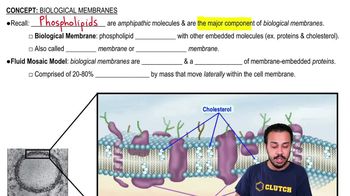
The plasma membrane is a selectively permeable boundary composed mainly of amphipathic lipids and proteins, forming a fluid mosaic model.
진행 상황 추적
컨트롤 버튼이 '내비게이션' 모드로 변경되었습니다.
1/28
추천 영상
02:21
Biological Membranes Example 1
20633
views
368
rank
1
comments
06:04
Biological Membranes
28268
views
524
rank
2
comments
이 집합의 용어 (28)
하이드의 정의
Plasma membrane structure
The plasma membrane is a selectively permeable boundary composed mainly of amphipathic lipids and proteins, forming a fluid mosaic model.
Fluid mosaic model
Describes the membrane as a mosaic of protein molecules bobbing in a fluid bilayer of phospholipids.
Membrane fluidity factors
Membrane fluidity is influenced by temperature, lipid composition (unsaturated vs saturated fatty acids), and cholesterol content.
Effect of unsaturated vs saturated fatty acid tails
Unsaturated tails increase fluidity due to kinks preventing tight packing; saturated tails decrease fluidity by packing tightly.
Role of cholesterol in membrane fluidity
Cholesterol reduces membrane fluidity at moderate temperatures but prevents solidification at low temperatures by disrupting packing.
Integral vs peripheral membrane proteins
Integral proteins penetrate the hydrophobic bilayer, often spanning it; peripheral proteins are loosely bound to membrane surfaces.
Six major functions of membrane proteins
Transport, enzymatic activity, signal transduction, cell-cell recognition, intercellular joining, and attachment to cytoskeleton/ECM.
Glycolipids and glycoproteins
Carbohydrates covalently bonded to lipids or proteins on the extracellular membrane surface, important for cell recognition.
Selective permeability of membranes
Hydrophobic molecules cross easily; larger polar molecules require transport proteins to cross the membrane.
Transport proteins types
Channel proteins provide hydrophilic tunnels; carrier proteins bind and shuttle molecules by changing shape.
Passive transport
Diffusion of substances across membranes down their concentration gradient without energy input.
Osmosis
Diffusion of water across a selectively permeable membrane from lower to higher solute concentration.
Tonicity effects on cells without walls
Hypotonic causes swelling/lysis; isotonic causes no net water movement; hypertonic causes shrinking.
Tonicity effects on plant cells
Hypotonic solution makes cells turgid; isotonic makes cells flaccid; hypertonic causes plasmolysis.
Facilitated diffusion
Passive transport aided by transport proteins moving molecules down their concentration gradient.
Active transport
Energy-requiring process moving substances against their concentration gradient using ATP.
Sodium-potassium pump
An active transport protein exchanging Na+ out and K+ into animal cells to maintain concentration gradients.
Membrane potential
Voltage across a membrane created by differences in ion distribution, resulting in a negatively charged cell interior.
Electrochemical gradient
Combined effect of membrane potential and ion concentration gradient driving ion diffusion.
Electrogenic pumps
Transport proteins that generate voltage across membranes, e.g., sodium-potassium pump and proton pump.
Cotransport
Coupled transport where downhill diffusion of one solute drives uphill transport of another against its gradient.
Bulk transport
Energy-requiring transport of large molecules via vesicles by exocytosis (out) and endocytosis (in).
Types of endocytosis
Phagocytosis (cell eating), pinocytosis (cell drinking), and receptor-mediated endocytosis.
Cell signaling stages
Reception (signal detection), transduction (signal conversion), and response (cellular activity).
Membrane receptors types
G protein-coupled receptors and ligand-gated ion channels.
Ligand-gated ion channel receptor
Receptor that acts as a gate for ions when a ligand binds, important in nervous system signaling.
Signal transduction cascade
Multiple-step molecular interactions amplifying a signal to produce a large cellular response.
Cellular response to signaling
Regulation of cytoplasmic activities or gene expression by turning genes on or off.
 뒤로뒤로
뒤로뒤로
 02:21
02:21