 뒤로
뒤로Mendelian Genetics and Patterns of Inheritance
 01:58
01:58
이 집합의 용어 (29)
Heredity is the transmission of traits from one generation to the next.
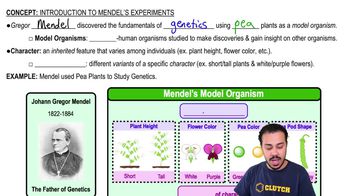
Gregor Mendel discovered that parents pass on discrete genes responsible for inherited traits, which retain their identity across generations.
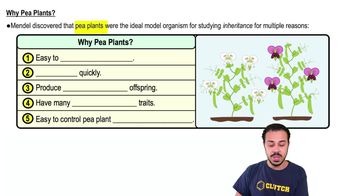
Garden peas were easy to grow and had distinct, easily distinguishable varieties for traits.
A character is a heritable feature that varies among individuals, while a trait is a variant of a character, such as flower color being a character and purple or white being traits.
A purebred variety is a plant that, when self-fertilized, produces offspring identical to itself for a specific trait.
A hybrid is the offspring of two different purebred varieties.
P generation are the purebred parents, F1 generation are their hybrid offspring, and F2 generation are the offspring from crossing F1 individuals.
Each organism inherits two alleles for a gene, which segregate during gamete formation so each gamete carries only one allele.
Homozygous means having two identical alleles for a gene; heterozygous means having two different alleles.
A dominant allele determines the organism's appearance when present, while a recessive allele has no noticeable effect in heterozygotes.
A Punnett square predicts the possible allele combinations and genotypes of offspring from a genetic cross.
The phenotypic ratio is 3 purple : 1 white flower color in the F2 generation.
Alleles of different genes assort independently during gamete formation, so inheritance of one trait does not affect another.
A cross between two organisms heterozygous for two characters, used to study independent assortment.
A testcross is a mating between an individual with a dominant phenotype but unknown genotype and a homozygous recessive individual to determine the unknown genotype.
Pedigrees are family trees used to analyze inheritance patterns of traits in humans.
Dominance means a heterozygous genotype results in the dominant phenotype, not that the trait is more common or normal.
Examples include freckles, widow's peak hairline, and some genetic disorders like cystic fibrosis and achondroplasia.
Incomplete dominance occurs when heterozygotes have an intermediate phenotype between the two homozygotes.
In codominance, both alleles are expressed equally, as in IAIB genotype producing type AB blood with both A and B carbohydrates.
Pleiotropy occurs when one gene influences multiple phenotypic traits, such as sickle-cell disease affecting red blood cells and causing multiple symptoms.
Polygenic inheritance is when multiple genes additively affect a single phenotypic character, like human height.
Transmission of traits through chemical modifications of DNA or chromosomal proteins that do not change the DNA sequence but can be inherited.
Genes are located at specific loci on chromosomes, and chromosome behavior during meiosis explains inheritance patterns.
Linked genes are genes located close together on the same chromosome and tend to be inherited together, not assorting independently.
Humans have sex chromosomes X and Y; XX individuals are female, XY individuals are male.
Genes located on sex chromosomes, mostly on the X chromosome, often showing unique inheritance patterns like red-green colorblindness.
It is a sex-linked recessive trait mostly affecting males, who have only one X chromosome.
Carriers have one recessive allele but do not show symptoms; they can pass the disorder to offspring if both parents are carriers.