Skip to main content
General Biology
나의 코스
배우기
시험 준비
AI 튜터
학습 가이드
교과서적 해결책
플래시카드
탐험해 보세요
앱을 사용해 보세요
나의 코스
배우기
시험 준비
AI 튜터
학습 가이드
교과서적 해결책
플래시카드
탐험해 보세요
앱을 사용해 보세요
뒤로
Nervous Systems in General Biology
카드를 뒤집기 위해 탭할 수 있습니다.
What is the primary role of a neuron?
카드를 뒤집기 위해 탭할 수 있습니다.
👆
What is the primary role of a neuron?
To receive and transmit electrical signals.
진행 상황 추적
컨트롤 버튼이 '내비게이션' 모드로 변경되었습니다.
1/23
추천 영상
12:47
Neurotransmitters
2717
views
21
rank
02:14
Nervous System
4743
views
78
rank
05:33
Postsynaptic Potentials and Summation
3389
views
17
rank
이 집합의 용어 (23)
하이드의 정의
What is the primary role of a neuron?
To receive and transmit electrical signals.
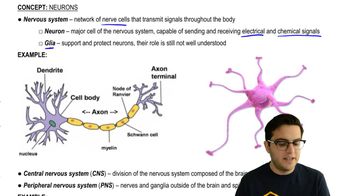
Name the main structural parts of a neuron.
Cell body, dendrites, and one long axon.
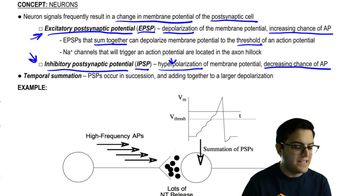
How do neurons transmit signals at synapses?
Electrically excited presynaptic terminals release neurotransmitters that may excite the postsynaptic cell.
What determines the charge inside a neuron during excitation?
Movement of ions across the membrane.
What is the refractory period in neurons?
The time between action potentials that sets the maximum frequency and ensures one-way propagation.
How is the speed of action potential propagation increased?
By larger axon diameter and myelin insulation.
What type of nervous system do cnidarians have?
A diffuse nerve net.
What is cephalization?
Concentration of the nervous system into a brain in bilaterally symmetrical animals.
What structures make up the central nervous system (CNS)?
The brain and spinal cord.
What is the peripheral nervous system (PNS) composed of?
Ganglia and nerves outside the CNS.
What are the two main types of neurons in the PNS?
Afferent neurons (sensory) and efferent neurons (motor).
What are the divisions of the autonomic nervous system?
Sympathetic (arousal), parasympathetic (calming), and enteric (digestion).
What is the function of the spinal cord?
Carries impulses to and from the brain and mediates reflexes.
What is the difference between gray and white matter in the CNS?
Gray matter is non-myelinated; white matter is myelinated.
What fluid fills the ventricles of the brain and central canal of the spinal cord?
Cerebrospinal fluid, which cushions and transports nutrients and waste.
Name the three embryonic brain regions and their adult derivatives.
Forebrain (cerebrum, diencephalon), midbrain (brainstem), hindbrain (pons, medulla, cerebellum).
What is the role of the cerebellum?
Coordinates movement and hand-eye coordination.
What functions are associated with the diencephalon?
Homeostasis, sensory coordination, and circadian rhythms.
What is the cerebral cortex responsible for?
Information processing, decision making, and controlling voluntary actions.
What are the four lobes of the cerebral cortex?
Frontal, parietal, occipital, and temporal lobes.
What is lateralization in the brain?
Functional differences between the left and right hemispheres.
How does the brain change after formation to support learning and memory?
Through neural plasticity involving synapse strengthening, neuron die-off, and synapse reconfiguration.
What is long-term potentiation?
A process where frequent synaptic excitation increases postsynaptic sensitivity.
 뒤로뒤로
뒤로뒤로
 12:47
12:47