 뒤로
뒤로Photosynthesis and Carbon Fixation in General Biology
 03:32
03:32
이 집합의 용어 (11)
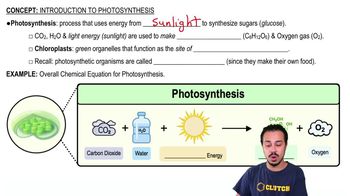
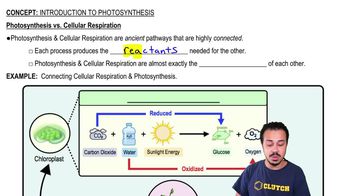
chloroplasts in plants capture light energy from the sun and convert it into chemical energy stored in sugars and other organic molecules.
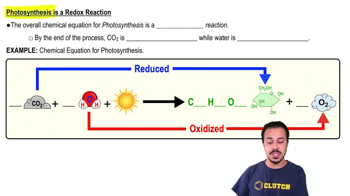
6CO2 + 6H2O + light energy \(\rightarrow\) C6H12O6 + 6O2
Water is oxidized into oxygen
Carbon Dioxided is reduced into glucose
The light reactions convert solar energy to ATP and NADPH, and the Calvin cycle uses ATP and NADPH to fix CO2 into sugar.
Light energy splits water, releases O2, and drives electron transport to produce ATP and NADPH in the thylakoid membranes.
A photosystem consists of a reaction-center complex with special chlorophyll a molecules and surrounding light-harvesting complexes that capture and funnel light energy.
Photosystem II (P680) absorbs light first
Photosystem I (P700) second in the light reactions.
Electrons flow from water through PS II, electron transport chain, PS I, and finally reduce NADP+ to NADPH, producing ATP and O2 as by-products.
Electrons cycle from PS I back to the cytochrome complex, generating ATP but no NADPH or O2; it may protect cells from light damage.
1. Carbon fixation by rubisco attaching CO2 to RuBP.
2. Reduction of 3-phosphoglycerate to G3P using ATP and NADPH.
3. Regeneration of RuBP using ATP.
Rubisco is the enzyme that catalyzes CO2 fixation to RuBP; it is the most abundant protein on Earth.
What part of the leave allows CO2 and Oz to diffuse
Stomata