 뒤로
뒤로Photosynthesis in General Biology
 03:32
03:32
이 집합의 용어 (20)
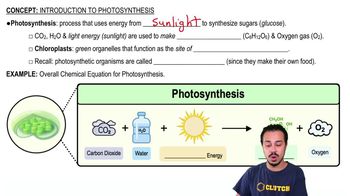
Photosynthesis is the process that converts solar energy into chemical energy, feeding almost the entire living world directly or indirectly.
Photosynthesis occurs in plants, algae, certain protists, and some prokaryotes, which are autotrophs producing organic molecules from CO2 and inorganic molecules.
Autotrophs sustain themselves without eating other organisms, producing organic molecules. Heterotrophs obtain organic material from other organisms and are consumers.
Photosynthesis occurs in chloroplasts, organelles found inside plant epidermal cells, giving leaves their green color.
Chloroplasts have two membranes, contain circular DNA in the stroma, and have thylakoids with chlorophyll. Thylakoids stack into grana, enabling photosynthesis reactions.
Plants appear green because chlorophyll pigments reflect and transmit green light, absorbing other wavelengths.
Chlorophyll a and chlorophyll b absorb mainly red and blue light. Carotenoids are accessory pigments absorbing violet and blue-green light and protect chlorophyll.
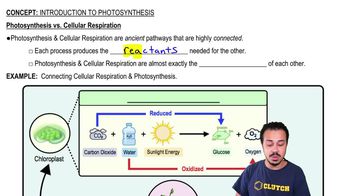
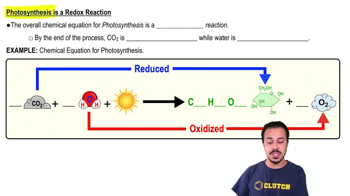
Energy + 6 CO2 + 6 H2O → C6H12O6 + 6 O2. CO2 is reduced to sugar, and H2O is oxidized to oxygen.
A redox reaction involves electron transfer: oxidation is loss of electrons, reduction is gain of electrons, transferring energy between molecules.
Redox reactions involve electron transfer between covalently bonded molecules, while ionic bonds are electromagnetic attractions between ions.
Photosynthesis has light-dependent reactions (photo part) and light-independent reactions or Calvin Cycle (synthesis part).
They occur in the thylakoid membranes, converting light energy to ATP and NADPH by splitting water and releasing oxygen.
A photosystem is a reaction-center complex with light-harvesting complexes that funnel photon energy to chlorophyll molecules for electron excitation.
Photosystem II (PS II) absorbs 680 nm light and initiates electron excitation by splitting water. Photosystem I (PS I) absorbs 700 nm light and helps produce NADPH.
Sunlight excites electrons in P680 chlorophyll, water is split to provide electrons, which pass through an electron transport chain creating an H+ gradient for ATP synthesis.
Light excites electrons in P700 chlorophyll, which are transferred to NADP+ reductase to reduce NADP+ to NADPH for the Calvin Cycle.
The Calvin Cycle is the light-independent reaction in the stroma that uses ATP and NADPH to fix CO2 into 3-carbon sugars like G3P.
1. Carbon fixation: CO2 attaches to RuBP catalyzed by rubisco.
2. Reduction: ATP and NADPH convert 3-phosphoglycerate to G3P.
3. Regeneration: G3P regenerates RuBP to continue the cycle.
For each G3P molecule, 9 ATP and 6 NADPH molecules are consumed in the Calvin Cycle.
Photosynthesis stores solar energy as chemical energy in sugars, produces oxygen for respiration, and provides carbon skeletons for organic molecules.