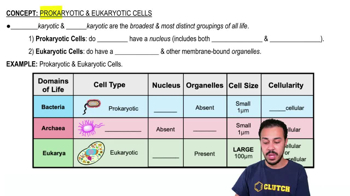
Bacteria and Archaea are the two domains of prokaryotes.
What are the three common shapes of prokaryotic cells?
The three common shapes are cocci (spherical), bacilli (rod-shaped), and spirals.
What is the main component of most bacterial cell walls?
Most bacterial cell walls contain peptidoglycan, a network of sugar polymers cross-linked by polypeptides.
How do Gram-positive and Gram-negative bacteria differ in cell wall structure?
Gram-positive bacteria have thick peptidoglycan layers; Gram-negative bacteria have thinner peptidoglycan and an outer membrane with lipopolysaccharides.
What is the function of a bacterial capsule?
The capsule is a sticky outer layer that helps bacteria adhere to surfaces and can protect pathogenic bacteria from the host immune system.
What is an endospore in prokaryotes?
An endospore is a metabolically inactive, resistant structure that can survive harsh conditions for centuries.
What are fimbriae and pili in prokaryotes?
Fimbriae are hairlike appendages for attachment; pili (sex pili) are longer and enable DNA exchange between cells.
What is taxis in prokaryotes?
Taxis is the ability to move toward or away from a stimulus, such as chemotaxis toward or away from chemicals.
How do prokaryotic flagella differ from eukaryotic flagella?
Prokaryotic flagella differ in structure, propulsion mechanism, and molecular composition from eukaryotic flagella.
Where is the prokaryotic chromosome located?
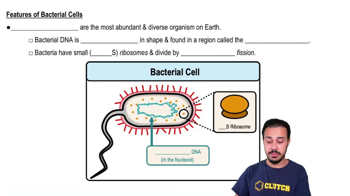
The chromosome is circular and located in the nucleoid region, which lacks a surrounding membrane.
What are plasmids in prokaryotes?
Plasmids are smaller, independently replicating rings of DNA separate from the main chromosome.
How do prokaryotes reproduce?
Prokaryotes reproduce asexually by binary fission, often dividing every 1–3 hours under optimal conditions.
What three factors contribute to genetic diversity in prokaryotes?
Rapid reproduction, mutation, and genetic recombination contribute to prokaryotic genetic diversity.
What is horizontal gene transfer?
Horizontal gene transfer is the movement of genes between individuals of different species.
Name three mechanisms of genetic recombination in prokaryotes.
Transformation (uptake of foreign DNA), transduction (gene transfer by phages), and conjugation (DNA transfer via pili).
What is the F factor in bacterial conjugation?
The F factor is a DNA segment required for pilus production and DNA transfer during conjugation.
What are R plasmids?
R plasmids carry genes for antibiotic resistance and can spread resistance between bacteria.
What are the four major nutritional modes of prokaryotes?
Photoautotroph, chemoautotroph, photoheterotroph, and chemoheterotroph, based on energy and carbon sources.
What is nitrogen fixation?
Nitrogen fixation is the conversion of atmospheric nitrogen (N2) to ammonia (NH3) by some prokaryotes.
What is a biofilm?
A biofilm is a surface-coating colony of prokaryotes that cooperate metabolically.
What roles do prokaryotes play in the biosphere?
Prokaryotes recycle chemical elements, decompose organic matter, and increase nutrient availability for plants.
What is symbiosis?
Symbiosis is a close ecological relationship between two species, such as mutualism, commensalism, or parasitism.
How do pathogenic bacteria cause disease?
Pathogens release exotoxins (secreted) or endotoxins (released when bacteria die) that cause disease symptoms.
How are prokaryotes used in biotechnology?
Prokaryotes are used in gene cloning, CRISPR gene editing, bioplastics production, ethanol production, and bioremediation.
 뒤로
뒤로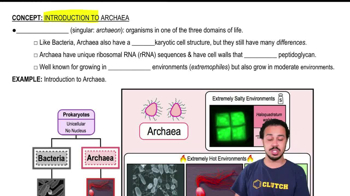
 04:39
04:39