Skip to main content
General Biology
나의 코스
배우기
시험 준비
AI 튜터
학습 가이드
교과서적 해결책
플래시카드
탐험해 보세요
앱을 사용해 보세요
나의 코스
배우기
시험 준비
AI 튜터
학습 가이드
교과서적 해결책
플래시카드
탐험해 보세요
앱을 사용해 보세요
뒤로
Protein Structure and Chemistry in General Biology
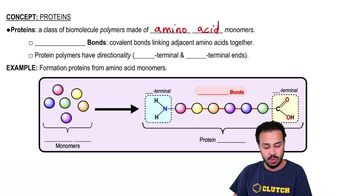
카드를 뒤집기 위해 탭할 수 있습니다.
What is a polypeptide?
카드를 뒤집기 위해 탭할 수 있습니다.
👆
What is a polypeptide?
A
polypeptide
is a polymer made up of amino acids linked by peptide bonds.
진행 상황 추적
컨트롤 버튼이 '내비게이션' 모드로 변경되었습니다.
1/20
추천 영상
08:02
Protein Structure
21620
views
284
rank
04:37
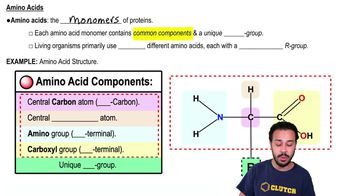
Amino Acids
22147
views
371
rank
02:50
Proteins
27159
views
479
rank
1
comments
이 집합의 용어 (20)
하이드의 정의
What is a polypeptide?
A
polypeptide
is a polymer made up of amino acids linked by peptide bonds.
What is the primary structure of a protein?
The
primary structure
is the linear sequence of amino acids in a polypeptide chain.
What type of bond links amino acid residues in a polypeptide?
A
peptide bond
links the carboxyl carbon of one amino acid to the amino nitrogen of the next.
Name the two most common forms of secondary protein structure.
The two most common secondary structures are the
alpha helix
and the
beta sheet
.
What forces stabilize the secondary structure of proteins?
Hydrogen bonds
between backbone atoms stabilize alpha helices and beta sheets.
What is the tertiary structure of a protein?
The
tertiary structure
is the overall 3D folding of a single polypeptide chain, including side chain orientations.
List the types of interactions that contribute to tertiary protein structure.
Tertiary structure is stabilized by
hydrogen bonds
,
ionic bonds
,
van der Waals forces
,
disulfide bonds
, and the
hydrophobic effect
.
What is quaternary protein structure?
The
quaternary structure
is the arrangement of multiple polypeptide subunits into a functional protein complex.
What is the role of hydrogen bonds in protein folding?
Hydrogen bonds
help maintain secondary and tertiary structures by stabilizing helices, sheets, and folded conformations.
What is an amino acid?
An
amino acid
is an organic molecule with an amino group, a carboxyl group, a hydrogen atom, and a variable side chain attached to a central carbon.
How are amino acids classified by side chain polarity?
Amino acids can be
polar noncharged
,
charged
, or
nonpolar
based on their side chain properties.
What is the significance of the R group in amino acids?
The
R group
determines the chemical nature and properties of each amino acid.
What chemical approach can denature a polypeptide?
Denaturation can be caused by disrupting hydrogen bonds and ionic interactions using heat, pH changes, or chemicals like urea.
What is the hydrophobic effect in protein folding?
The
hydrophobic effect
drives nonpolar side chains to the protein interior, stabilizing the folded structure.
What atoms are involved in peptide bond formation?
Peptide bonds form between the
carboxyl carbon
of one amino acid and the
amino nitrogen
of another, releasing water.
What is the role of disulfide bonds in proteins?
Disulfide bonds
are covalent links between cysteine residues that stabilize tertiary and quaternary structures.
What is the difference between covalent and hydrogen bonds in proteins?
Covalent bonds
are strong and form the backbone, while
hydrogen bonds
are weaker and stabilize folding.
What is the significance of the alpha helix in proteins?
The
alpha helix
is a common secondary structure stabilized by hydrogen bonds, forming a right-handed coil.
What is the beta sheet structure?
The
beta sheet
consists of beta strands connected laterally by hydrogen bonds, forming a sheet-like arrangement.
How does the quaternary structure affect protein function?
Quaternary structure allows multiple subunits to interact, enabling cooperative function and regulation.
 뒤로뒤로
뒤로뒤로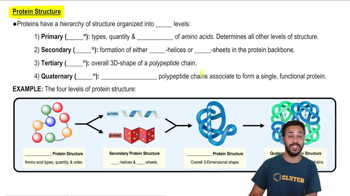
 08:02
08:02