 뒤로
뒤로Regulation of Gene Expression
 02:17
02:17
이 집합의 용어 (20)
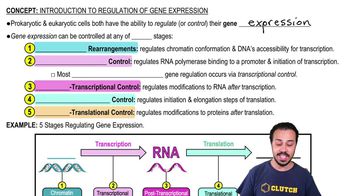
Gene expression is the process by which information from a gene is used to synthesize functional gene products like proteins or RNA.
It allows cells to respond to their environment, differentiate, and conserve energy by producing proteins only when needed.
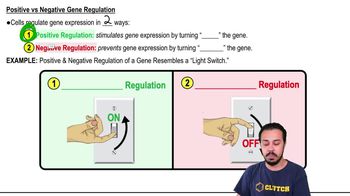
Gene expression is mainly regulated at the transcriptional and post-transcriptional levels.
Transcription factors bind to specific DNA sequences to increase or decrease transcription of target genes.
An operon is a cluster of genes under control of a single promoter, allowing coordinated regulation in prokaryotes.
The lac operon is activated in the presence of lactose and absence of glucose, enabling transcription of genes for lactose metabolism.
An enhancer is a DNA sequence that increases transcription levels by binding activator proteins, often located far from the gene.
Epigenetic regulation involves heritable changes in gene expression without altering DNA sequence, such as DNA methylation and histone modification.
DNA methylation typically represses gene expression by preventing transcription factor binding or recruiting repressive proteins.
Histone acetylation loosens chromatin structure, making DNA more accessible and promoting transcription.
RNA interference is a post-transcriptional gene silencing mechanism using small RNAs to degrade or block translation of target mRNAs.
MicroRNAs bind complementary mRNA sequences to inhibit translation or promote degradation.
Alternative splicing allows a single gene to produce multiple protein variants by including or excluding certain exons.
Prokaryotes often regulate genes in operons; eukaryotes use complex regulation including chromatin remodeling and multiple transcription factors.
Promoters are DNA sequences where RNA polymerase binds to initiate transcription.
Inducible operons are usually off and turned on by a substrate; repressible operons are usually on and turned off by a product.
Repressors are proteins that bind DNA to block transcription.
Compact chromatin (heterochromatin) is transcriptionally inactive; open chromatin (euchromatin) is accessible for transcription.
Transcriptional activators enhance gene expression by facilitating RNA polymerase binding and transcription initiation.
Post-translational modifications can alter protein activity, stability, or localization, affecting gene expression outcomes.