Skip to main content
General Biology
나의 코스
배우기
시험 준비
AI 튜터
학습 가이드
교과서적 해결책
플래시카드
탐험해 보세요
앱을 사용해 보세요
나의 코스
배우기
시험 준비
AI 튜터
학습 가이드
교과서적 해결책
플래시카드
탐험해 보세요
앱을 사용해 보세요
뒤로
The Cell Cycle and Cell Division
카드를 뒤집기 위해 탭할 수 있습니다.
Key roles of cell division
카드를 뒤집기 위해 탭할 수 있습니다.
👆
Key roles of cell division
Unicellular organisms:
reproduction.
Multicellular eukaryotes:
development from fertilized egg, growth, and repair.
진행 상황 추적
컨트롤 버튼이 '내비게이션' 모드로 변경되었습니다.
1/24
추천 영상
04:45
Asexual vs. Sexual Reproduction
16850
views
360
rank
3
comments
09:40
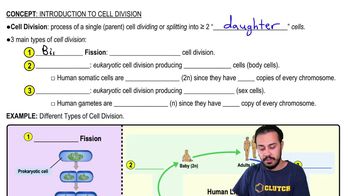
Introduction to Cell Division
25709
views
579
rank
1
comments
03:19
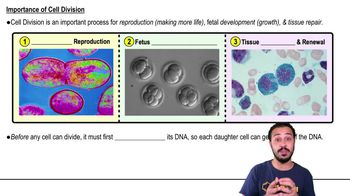
Importance of Cell Division
16037
views
515
rank
이 집합의 용어 (24)
하이드의 정의
Key roles of cell division
Unicellular organisms:
reproduction.
Multicellular eukaryotes:
development from fertilized egg, growth, and repair.
Difference between somatic cells and gametes
Somatic cells
are body cells with two sets of chromosomes.
Gametes
are reproductive cells with one set of chromosomes.
Sister chromatids and centromeres
Sister chromatids are identical copies of a chromosome joined at a
centromere
by protein complexes called
cohesins
.
Phases of the cell cycle
The cell cycle includes
interphase
(G1, S, G2 phases) and the
mitotic phase
(mitosis and cytokinesis).
What happens during S phase?
DNA synthesis occurs, duplicating chromosomes to form sister chromatids.
Main events of mitosis
Prophase, prometaphase, metaphase, anaphase, and telophase lead to equal chromosome separation into two daughter nuclei.
Role of the mitotic spindle
The mitotic spindle, made of microtubules, organizes and separates chromosomes during mitosis.
How do kinetochore microtubules shorten during anaphase?
They shorten at the kinetochore ends, pulling sister chromatids toward spindle poles.
Binary fission in bacteria
Bacterial cell division where the chromosome replicates and the cell splits into two daughter cells.
Cell cycle checkpoints
Control points (G1, G2, M) where the cell cycle can be paused to ensure proper division.
Molecular control at G2 checkpoint
Cyclin-dependent kinases (Cdks) and cyclins regulate progression to mitosis by activating MPF.
G1 checkpoint function
Determines if the cell will proceed to DNA synthesis or enter a resting state (G0).
M checkpoint function
Ensures all chromosomes are properly attached to the spindle before anaphase proceeds.
Effect of platelet-derived growth factor (PDGF)
PDGF stimulates cell division by signaling cells to pass the G1 checkpoint.
Density-dependent inhibition
Normal cells stop dividing when crowded; cancer cells lose this control and divide uncontrollably.
Characteristics of cancer cells
Cancer cells may produce their own growth factors, ignore growth signals, or have defective cell cycle controls.
Difference between benign and malignant tumors
Benign tumors are localized; malignant tumors invade other tissues and can metastasize.
Chromosome sets in humans
Humans have 23 pairs of chromosomes; diploid cells have two sets (2n), haploid gametes have one set (n).
Homologous chromosomes
Pairs of chromosomes, one from each parent, that have the same genes but may have different alleles.
Three unique events in meiosis
Synapsis and crossing over, homologous pairs align at metaphase plate, and separation of homologs during anaphase I.
Comparison of mitosis and meiosis
Mitosis produces two identical diploid cells; meiosis produces four genetically diverse haploid cells.
Origins of genetic variation
Independent assortment, crossing over, and random fertilization increase genetic diversity.
Independent assortment formula
Number of chromosome combinations = \(2^n\), where n is haploid number.
Random fertilization
Any sperm can fuse with any egg, creating about 70 trillion possible diploid combinations in humans.
 뒤로뒤로
뒤로뒤로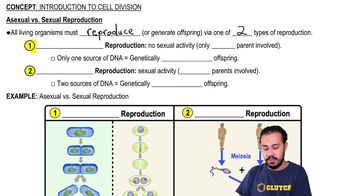
 04:45
04:45