 뒤로
뒤로The Chemistry and Structure of the Cell
 02:13
02:13
이 집합의 용어 (20)
An atom is the smallest unit of an element that retains its chemical properties.
Atoms are made of electrons (negative charge), protons (positive charge), and neutrons (neutral).
The nucleus is composed of protons and neutrons.
Atomic number is the number of protons; atomic mass is the sum of protons and neutrons in the nucleus.
Isotopes are atoms of the same element with different numbers of neutrons.
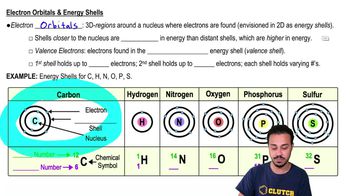
Electrons are found in orbitals, areas around the nucleus where electrons are likely to be found.
Common orbitals include s, p, d, and f orbitals, each with distinct shapes.
Orbitals describe locations of electrons; shells represent energy levels of electrons.
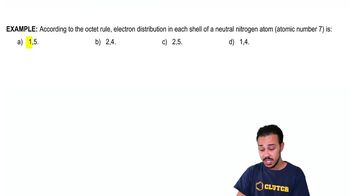
Atoms tend to gain or lose electrons to fill their outermost shell with 8 electrons, achieving stability.
Valence electrons are electrons in the outermost shell that determine chemical properties and reactivity.
A molecule is a group of atoms held together by chemical bonds; a compound contains atoms of more than one element.
An ionic bond forms by attraction between oppositely charged ions (cations and anions).
A covalent bond forms when two atoms share one or more pairs of valence electrons.
The number of shared electron pairs determines bond strength; more shared pairs mean stronger bonds.
Nonpolar covalent bonds share electrons equally; polar covalent bonds share electrons unequally due to electronegativity differences.
Electronegativity is an atom's affinity for electrons, influencing bond polarity.
Hydrogen bonds are weak attractions between polar molecules involving hydrogen atoms.
Electrons, especially valence electrons, are involved in forming and breaking chemical bonds during reactions.
Electrons occupy energy levels; moving between levels involves absorbing or releasing energy.
Cations are positively charged ions (lost electrons); anions are negatively charged ions (gained electrons).