 뒤로
뒤로Ultrastructure of Prokaryotes and Eukaryotes
 04:26
04:26
이 집합의 용어 (20)
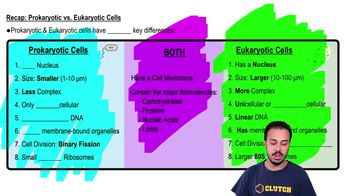
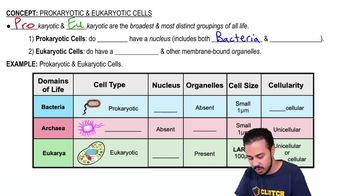
A prokaryote is a unicellular organism without a nucleus or membrane-bound organelles.
A eukaryote is an organism whose cells contain a nucleus and membrane-bound organelles.
Prokaryotes lack a nucleus and membrane-bound organelles; eukaryotes have both.
The cell wall provides structural support and protection in prokaryotes.
The plasma membrane controls the movement of substances in and out of the cell.
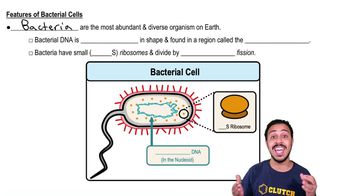
The nucleoid is the region in prokaryotes where the circular DNA is located, not enclosed by a membrane.
The nucleus contains the cell's DNA enclosed within a double membrane.
Ribosomes are the sites of protein synthesis in both prokaryotic and eukaryotic cells.
Prokaryotic ribosomes are 70S; eukaryotic ribosomes are 80S in size.
Mitochondria generate ATP through cellular respiration in eukaryotic cells.
Chloroplasts conduct photosynthesis in plant eukaryotic cells.
The rough ER synthesizes proteins; the smooth ER synthesizes lipids and detoxifies substances.
The Golgi apparatus modifies, sorts, and packages proteins and lipids for transport.
Flagella and pili help prokaryotes move and attach to surfaces.
The cytoskeleton provides structural support and aids in intracellular transport and cell division.
The capsule is a protective outer layer that helps prokaryotes evade the immune system.
Prokaryotic DNA is circular and free in the cytoplasm; eukaryotic DNA is linear and enclosed in the nucleus.
Lysosomes contain enzymes that digest waste materials and cellular debris.
Vacuoles store nutrients, waste products, and help maintain turgor pressure in plant cells.
Prokaryotic cells are generally smaller (1-10 µm) than eukaryotic cells (10-100 µm).