 뒤로
뒤로Unit 2 Chapter 7 (Summer test)
 07:06
07:06
이 집합의 용어 (35)
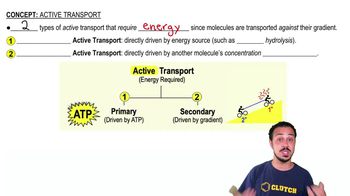
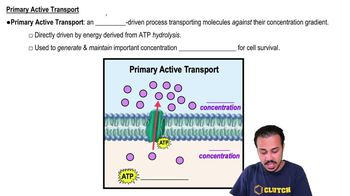
Movement of a substance across a biological membrane against its concentration or electrochemical gradient with the help of energy input and specific transport proteins
A molecule that has both a hydrophilic region and a hydrophobic region.
A transport protein in the plasma membrane of a plant or animal cell that specifically facilitates the diffusion of water across the membrane (osmosis)
An increase or decrease in the density of a chemical substance in an area. Cells often maintain concentration gradients of ions across their membranes. When a gradient exists, the ions or other chemical substances involved tend to move from where they are more concentrated to where they are less .
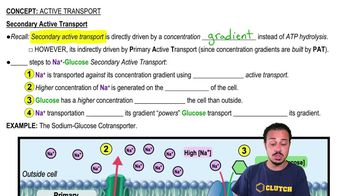
The coupling of the down hill diffusion of one substance to the uphill transport of another against its own concentration gradient.
The spontaneous tendency of a substance to move down its concentration gradient from a more concentrated to a less concentrated area.
The diffusion gradient of an ion, representing a type of potential energy that accounts for both the concentration difference of the ion across a membrane and its tendency to move relative to the membrane potential.
The cellular uptake of macromolecules and particulate substances by localized regions of the plasma membrane that surround the substance and pinch off to form an intracellular vesicle.
The cellular secretion of macromolecules by the fusion of vesicles with the plasma membrane.
The spontaneous passage of molecules and ions, bound to specific carrier proteins, across a biological membrane down their concentration gradients.
Limp. A walled cell is flaccid in surroundings where there is no tendency for water to enter.
The currently accepted model of cell membrane structure, which envisions the membrane as a mosaic of individually inserted protein molecules drifting laterally in a fluid bilayer of phospholipids.
A protein channel in a cell membrane that opens or closes in response to a particular stimulus.
A protein covalently attached to a carbohydrate.
In comparing two solutions, referring to the one with a greater solute concentration.
In comparing two solutions, referring to the one with a lower solute concentration.
Typically a transmembrane protein with hydrophobic regions that completely spans the hydrophobic interior of the membrane.
Protein channel in a cell membrane that allows passage of a specific ion down its concentration gradient.
Having the same solute concentration as another solution
A molecule that binds specifically to a receptor site of another molecule.
The charge difference between a cells cytoplasm and the extracellular fluid, due to the differential distribution of ions. Membrane potential affects the activity of excitable cells and the transmembrane movement of all charged substances.
The regulation of solute and water concentrations in body fluids by organisms living in hyperosmotic, hypoosmotic, and terrestrial environments.
The diffusion of water across a selectively permeable membrane.
The diffusion of a substance across a biological membrane.
A protein appendage loosely bound to the surface of a membrane and not embedded in the lipid bilayer.
A type of endocytosis involving large, particulate substances, accomplished mainly by macrophages, neutrophils, and dendritic cells.
A type of endocytosis in which the cell ingests extracellular fluid and its dissolved solutes.
A phenomenon in walled cells in which the cytoplasm shrivels and the plasma membrane pulls away from the cell wall when the cell loses water to a hypertonic environment.
An active transport mechanism in cell membranes that uses ATP to force hydrogen ions out of a cell, generating a membrane potential in the process.
The movement of specific molecules into a cell by the inward budding of membranous vesicles containing proteins with receptor sites specific to the molecules being taken in; enables a cell to acquire bulk quantities of specific substances.
A property of biological membranes that allows some substances to cross more easily than others
A special transport protein in the plasma membrane of animal cells that transports sodium out of the cell and potassium into the cell against their concentration gradients.
The ability of a solution to cause a cell within it to gain or lose water
A transmembrane protein that helps a certain substance or class of closely related substances to cross the membrane.
Very firm. A walled cell become turgid if it has a greater solute concentration than its surroundings, resulting in entry of water.