 뒤로
뒤로Water and Life - General Biology
 05:03
05:03
이 집합의 용어 (20)
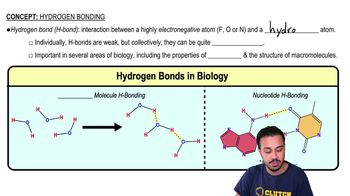
Hydrogen bonds form between the partial positive hydrogen of one water molecule and the partial negative oxygen of another.
Because oxygen is more electronegative than hydrogen, electrons are shared unequally, creating partial charges and a polar molecule.
Cohesion, moderation of temperature, expansion upon freezing, and versatility as a solvent.
Cohesion from hydrogen bonding between water molecules creates high surface tension.
Cohesion holds water molecules together; adhesion helps water stick to plant cell walls, enabling upward transport against gravity.
Specific heat is the heat needed to raise 1 g of a substance by 1°C. Water's high specific heat is due to hydrogen bonding, which absorbs heat when bonds break.
Water absorbs and releases large amounts of heat with little temperature change, stabilizing air temperatures near large bodies of water.
Water expands upon freezing, making ice less dense than liquid water, so it floats.
Water's polarity allows it to form hydrogen bonds with charged and polar molecules, dissolving many substances.
A sphere of water molecules surrounding dissolved ions, keeping them separated and dispersed in solution.
Hydrophilic substances have an affinity for water; hydrophobic substances repel water, often due to nonpolar bonds.
Molarity is the number of moles of solute per liter of solution.
Water molecules split into hydrogen ions (H⁺) and hydroxide ions (OH⁻) in a reversible reaction.
The pH scale measures hydrogen ion concentration, defined as \(pH = -\log[H^+]\), ranging from 0 (acidic) to 14 (basic).
Acidic: [H⁺] > [OH⁻]; Basic: [OH⁻] > [H⁺]; Neutral: [H⁺] = [OH⁻].
An acid increases H⁺ concentration; a base reduces H⁺ concentration in solution.
Ammonia (NH₃) accepts H⁺ ions reversibly, forming ammonium (NH₄⁺), thus reducing free H⁺ concentration.
Buffers minimize pH changes by accepting or donating H⁺ ions, maintaining stable pH in cells and blood.
Carbonic acid (H₂CO₃) reversibly dissociates into bicarbonate (HCO₃⁻) and H⁺, regulating blood pH.
Blood pH near 7.4 is vital; deviations can be fatal within minutes due to enzyme and cellular dysfunction.