Skip to main content
General Biology
나의 코스
배우기
시험 준비
AI 튜터
학습 가이드
교과서적 해결책
플래시카드
탐험해 보세요
앱을 사용해 보세요
나의 코스
배우기
시험 준비
AI 튜터
학습 가이드
교과서적 해결책
플래시카드
탐험해 보세요
앱을 사용해 보세요
뒤로
Water and Molecular Bonds in General Biology
카드를 뒤집기 위해 탭할 수 있습니다.
What type of bond shares electrons equally between atoms?
카드를 뒤집기 위해 탭할 수 있습니다.
👆
What type of bond shares electrons equally between atoms?
Nonpolar covalent bonds
share electrons equally, such as in C-C or C-H bonds.
진행 상황 추적
컨트롤 버튼이 '내비게이션' 모드로 변경되었습니다.
1/20
추천 영상
1:59
Introduction to Chemical Bonding Example 1
8699
views
168
rank
03:53
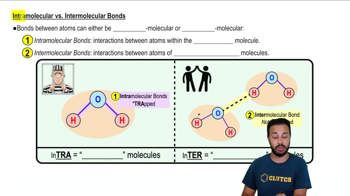
Intramolecular vs. Intermolecular Bonds
21510
views
414
rank
1
comments
02:42
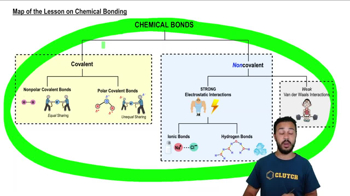
Map of the Lesson on Chemical Bonding
19748
views
278
rank
이 집합의 용어 (20)
하이드의 정의
What type of bond shares electrons equally between atoms?
Nonpolar covalent bonds
share electrons equally, such as in C-C or C-H bonds.
What makes a covalent bond polar?
Polar covalent bonds
share electrons unequally due to differences in electronegativity, e.g., O-H bonds.
Why is water (H2O) a polar molecule?
Water is polar because oxygen is more electronegative than hydrogen, causing electrons to spend more time near oxygen, creating partial charges.
What is the shape and bond angle of a water molecule?
Water has a
bent molecular shape
with a bond angle of about \(104.4^\circ\) due to lone pairs on oxygen.
How does molecular shape affect polarity?
Asymmetrical shapes like water create polarity, while symmetrical shapes like methane (CH4) are nonpolar.
What is electronegativity and its role in bond polarity?
Electronegativity is an atom's ability to attract electrons; differences cause polar covalent bonds.
What is a hydrogen bond?
A
hydrogen bond
is a weak attraction between a partially positive hydrogen and a partially negative atom like oxygen or nitrogen.
Are electrons shared in hydrogen bonds?
No, hydrogen bonds are
noncovalent
and do not involve electron sharing.
Why are hydrogen bonds important in biology?
They stabilize structures like DNA double helix and protein folding, and contribute to water's unique properties.
What are emergent properties of water due to hydrogen bonding?
Cohesion, adhesion, high specific heat, ice floating, and solvent abilities.
What does hydrophilic mean?
Hydrophilic
molecules are polar and interact well with water.
What does hydrophobic mean?
Hydrophobic
molecules are nonpolar and do not dissolve in water.
How does water moderate temperature changes?
Water's high specific heat allows it to absorb heat with little temperature change, stabilizing environments.
Why does ice float on water?
Ice is less dense because stable hydrogen bonds form a crystal lattice that spaces molecules apart.
What is the pH scale a measure of?
The pH scale measures the concentration of hydrogen ions \([H^+]\) in a solution.
How is pH calculated?
pH = \(-\log_{10}[H^+]\), a logarithmic scale.
What is the pH of pure water and why?
Pure water has a neutral pH of 7 because \([H^+] = [OH^-]\).
What is the difference between acids and bases in terms of H+ ions?
Acids donate H+ ions and lower pH; bases accept H+ ions and raise pH.
What role do buffers play in biological systems?
Buffers resist changes in pH by absorbing or releasing H+ ions.
How do ionic compounds like salt dissolve in water?
Water molecules surround ions, with oxygen attracting cations and hydrogen attracting anions, separating them.
 뒤로뒤로
뒤로뒤로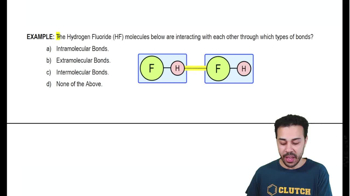
 1:59
1:59