뒤로

Water and Nutrient Transport in Plants

컨트롤 버튼이 '내비게이션' 모드로 변경되었습니다.
1/21
  • Define solute potential (ψS) and its effect on water movement.

    Water moves from high to low solute potential.

  • What is pressure potential (ψP) and how does it affect water movement?

    Water moves from high to low pressure potential when membranes are absent.

  • What is turgor pressure and its role in plant cells?

    Maintains cell rigidity

  • Explain plasmolysis and wilting in plant cells.

    Shrinking of the protoplast due to water loss

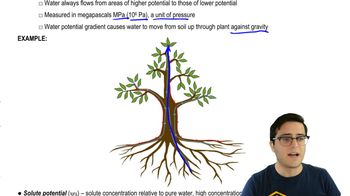
  • How does water potential vary in soil and affect plant water uptake?

    Dry soil has lower water potential than roots, damp soil has higher water potential. If soil water potential is too low, water can flow from plant to soil.
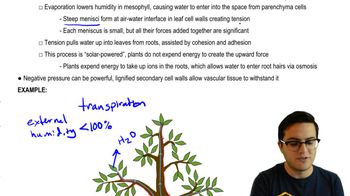
  • What is transpiration and how do stomata regulate it?

    Transpiration is water evaporation through leaves. Stomata open and close to control gas exchange and water loss, regulated by H+-pumps, K+ influx, and ABA hormone.
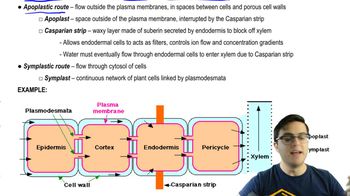
  • Describe the three routes water takes to move from soil to xylem.

    Transmembrane route: through membranes and aquaporins. Apoplastic route: through cell walls and spaces, blocked by Casparian strip. Symplastic route: through cytosol connected by plasmodesmata.
  • What is the Casparian strip and its function?

    The Casparian strip is a waxy suberin layer in endodermis that blocks apoplastic flow, forcing water and ions to cross membranes for selective uptake.
  • Explain bulk flow in xylem transport.

    Bulk flow is the mass movement of water and solutes along a pressure gradient through xylem vessels without crossing membranes.
  • What is the cohesion-tension theory of water transport?

    Water evaporates from leaves creating negative pressure (tension) that pulls water upward through xylem, aided by cohesion between water molecules and adhesion to xylem walls.
  • How does root pressure contribute to water movement?

    Root pressure builds positive pressure in xylem by ion pumping and water osmosis, pushing water upward, especially at night when transpiration is low.
  • Define capillary action and its components.

    Capillary action is liquid movement through narrow spaces due to adhesion (water to surface), cohesion (water to water), and surface tension.
  • What is translocation in plants?

    Translocation is the movement of sugars via phloem from source (sugar-producing tissue) to sink (sugar-consuming tissue) by bulk flow.
  • Describe the pressure flow hypothesis for phloem transport.

    Sugars loaded at source increase phloem osmotic pressure, drawing water in and raising turgor pressure. At sink, sugars unloaded, water exits, lowering pressure, driving bulk flow.
  • What are macronutrients and micronutrients in plant nutrition?

    Macronutrients (N, P, K, Ca, S, Mg) are needed in large amounts. Micronutrients (B, Cl, Mn, Fe, Zn, Cu, Na, Mo, Ni) are needed in trace amounts but essential.
  • What is soil texture and why is it important?

    Soil texture is the proportion of sand, silt, and clay affecting root penetration, water retention, and nutrient availability.
  • Explain cation exchange in soil nutrient uptake.

    Soil particles hold cations; protons released by roots displace nutrient cations (Ca2+, Mg2+, K+) making them available for plant absorption.
  • How do plants selectively absorb ions from soil?

    Plants use proton pumps to create electrochemical gradients, allowing cations to enter via channels and anions via cotransporters, filtering harmful ions.
  • What is nitrogen fixation and which organisms perform it?

    Nitrogen fixation converts atmospheric N2 to NH3 by bacteria and archaea, especially rhizobia in legume root nodules.
  • Describe the mutualistic relationship between legumes and rhizobia.

    Legumes provide carbohydrates and protection; rhizobia fix nitrogen into usable forms. Nodules form where bacteria infect roots, aided by signaling molecules.
  • What are mycorrhizae and their role in plant nutrition?

    Mycorrhizae are symbiotic associations between fungi and roots that increase nutrient absorption by extending root surface area.