
Ch. 1 - Evolution, the Themes of Biology, and Scientific Inquiry
Campbell - Campbell Biology 12th Edition
Urry12th EditionCampbell BiologyISBN: 9785794169850당신이 사용하는 게 아니라요?교과서 변경
1장, 문제 4

A controlled experiment is one that
a. Proceeds slowly enough that a scientist can make careful records of the results.
b. Tests experimental and control groups in parallel.
c. Is repeated many times to make sure the results are accurate.
d. Keeps all variables constant.

검증된 단계별 안내
1
Understand the concept of a controlled experiment: A controlled experiment is designed to test the effect of a single variable while keeping all other variables constant.
Identify the key components of a controlled experiment: It typically involves an experimental group and a control group. The experimental group is exposed to the variable being tested, while the control group is not.
Consider the purpose of having a control group: The control group serves as a baseline to compare the results of the experimental group, helping to isolate the effects of the variable being tested.
Evaluate the options given in the problem: Analyze each option to determine which one accurately describes the nature of a controlled experiment.
Select the option that best fits the definition of a controlled experiment: The correct choice should reflect the parallel testing of experimental and control groups, which is a fundamental aspect of controlled experiments.

비슷한 문제에 대한 검증된 영상 답변:

이 영상 해법은 위 문제에 도움이 된다고 튜터들이 추천한 것입니다.
영상 길이:
1m
도움이 되었나요?

주요 개념

질문에 올바르게 답하기 위해 반드시 이해해야 하는 핵심 개념들은 다음과 같습니다.

Controlled Experiment

A controlled experiment is a scientific test where all variables are kept constant except for the one being tested. This allows researchers to isolate the effects of the independent variable on the dependent variable, ensuring that any observed changes are due to the manipulation of the independent variable alone.
추천 영상:
08:56
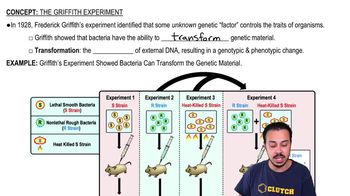
The Griffith Experiment

Experimental and Control Groups

In a controlled experiment, the experimental group is exposed to the independent variable, while the control group is not. This parallel testing allows scientists to compare outcomes between the two groups, helping to determine the effect of the independent variable by providing a baseline for comparison.
추천 영상:
07:42
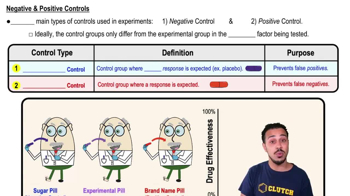
Negative & Positive Controls

Variable Control

Variable control involves maintaining all other variables constant except the one being tested. This is crucial in experiments to ensure that any changes in the dependent variable are directly attributable to the independent variable, thus eliminating confounding factors and enhancing the reliability of the results.
추천 영상:
07:36
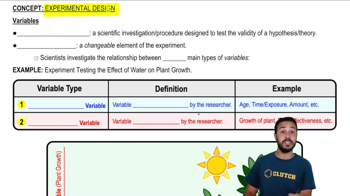
Variables
관련 실천
교과서 질문

Which of the following statements best distinguishes hypotheses from theories in science?

a. Theories are hypotheses that have been proved.

b. Hypotheses are guesses; theories are correct answers.

c. Hypotheses usually are relatively narrow in scope; theories have broad explanatory power.

d. Theories are proved true; hypotheses are often contradicted by experimental results.

4386
views
교과서 질문

Which of the following best demonstrates the unity among all organisms?

a. Emergent properties

b. Descent with modification

c. The structure and function of DNA

d. Natural selection

1765
views
교과서 질문

Which of the following is an example of qualitative data?

a. The fish swam in a zigzag motion.

b. The contents of the stomach are mixed every 20 seconds.

c. The temperature decreased from 20°C to 15°C.

d. The six pairs of robins hatched an average of three chicks each.

3287
views
교과서 질문

All the organisms on your campus make up

a. An ecosystem

b. A community

c. A population

d. A taxonomic domain

3766
views
교과서 질문

Systems biology is mainly an attempt to

a. Analyze genomes from different species.

b. Simplify complex problems by reducing the system into smaller, less complex units.

c. Understand the behavior of entire biological systems by studying interactions among their component parts.

d. Build high-throughput machines for the rapid acquisition of biological data.

2651
views
7
rank
교과서 질문

Which sentence best describes the logic of scientific inquiry?

a. If I generate a testable hypothesis, tests and observations will support it.

b. If my prediction is correct, it will lead to a testable hypothesis.

c. If my observations are accurate, they will support my hypothesis.

d. If my hypothesis is correct, I can expect certain test results.

3392
views