Ch. 10 - Photosynthesis
Campbell - Campbell Biology 12th Edition
Urry12th EditionCampbell BiologyISBN: 9785794169850당신이 사용하는 게 아니라요?교과서 변경
10장, 문제 2

Which of the following sequences correctly represents the flow of electrons during photosynthesis?
a. NADPH → O2 → CO2
b. H2O → NADPH → Calvin cycle
c. H2O → photosystem I → photosystem II
d. NADPH → electron transport chain → O2

검증된 단계별 안내
1
Understand the process of photosynthesis, which involves two main stages: the light-dependent reactions and the Calvin cycle (light-independent reactions).
In the light-dependent reactions, water (H2O) is split to release electrons, protons, and oxygen (O2). This occurs in the thylakoid membranes of chloroplasts.
These electrons are transferred through a series of proteins known as the electron transport chain, which includes photosystem II and photosystem I.
The electrons eventually reduce NADP+ to form NADPH, which is then used in the Calvin cycle to help convert carbon dioxide (CO2) into glucose.
Identify the correct sequence of electron flow during photosynthesis: H2O provides electrons, which move through photosystem II and photosystem I, and are finally used to form NADPH, which is utilized in the Calvin cycle.

비슷한 문제에 대한 검증된 영상 답변:

이 영상 해법은 위 문제에 도움이 된다고 튜터들이 추천한 것입니다.
영상 길이:
3m

주요 개념

질문에 올바르게 답하기 위해 반드시 이해해야 하는 핵심 개념들은 다음과 같습니다.

Photosynthesis Electron Flow

During photosynthesis, electrons flow from water (H2O) through the photosystems and into the Calvin cycle. Initially, water molecules are split in photosystem II, releasing electrons, which then move through the electron transport chain to photosystem I, where they are used to reduce NADP+ to NADPH. This NADPH is then utilized in the Calvin cycle to help convert CO2 into glucose.
추천 영상:

Photosystems I and II

Photosystems I and II are integral components of the light-dependent reactions in photosynthesis. Photosystem II captures light energy to initiate the electron transport chain by splitting water molecules, releasing oxygen and electrons. Photosystem I further energizes these electrons using light energy, facilitating their transfer to NADP+, forming NADPH, which is crucial for the Calvin cycle.
추천 영상:
06:17
Meiosis II

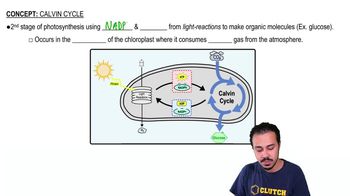
Calvin Cycle

The Calvin cycle, also known as the light-independent reactions, occurs in the stroma of chloroplasts and uses ATP and NADPH produced in the light-dependent reactions to convert carbon dioxide into glucose. This cycle involves carbon fixation, reduction, and regeneration of ribulose bisphosphate, enabling plants to synthesize sugars necessary for growth and energy storage.
추천 영상:
03:42
Calvin Cycle