Ch. 12 - The Cell Cycle
Campbell - Campbell Biology 12th Edition
Urry12th EditionCampbell BiologyISBN: 9785794169850당신이 사용하는 게 아니라요?교과서 변경
12장, 문제 10

Draw one eukaryotic chromosome as it would appear during interphase, during each of the stages of mitosis, and during cytokinesis. Also, draw and label the nuclear envelope and any microtubules attached to the chromosome(s).

검증된 단계별 안내
1
Start by drawing a eukaryotic chromosome during interphase. In this stage, the chromosome is not visible as a distinct structure because it is in the form of chromatin, which is a relaxed and extended form. Label the nuclear envelope surrounding the chromatin.
Next, draw the chromosome during prophase. Here, the chromatin condenses into visible chromosomes. Each chromosome consists of two sister chromatids joined at the centromere. Draw and label the nuclear envelope, which begins to break down, and the spindle fibers (microtubules) starting to form.
Proceed to draw the chromosome during metaphase. The chromosomes align at the metaphase plate (center of the cell). Draw and label the spindle fibers attached to the centromeres of the chromosomes, and note that the nuclear envelope is completely disintegrated.
Draw the chromosome during anaphase. The sister chromatids are pulled apart by the spindle fibers towards opposite poles of the cell. Label the spindle fibers and indicate the movement of chromatids.
Finally, draw the chromosome during telophase and cytokinesis. In telophase, the chromatids reach the poles and begin to de-condense back into chromatin. The nuclear envelope re-forms around each set of chromatin. During cytokinesis, the cell membrane pinches in to divide the cytoplasm, resulting in two separate cells. Label the re-formed nuclear envelopes and the division of the cytoplasm.

비슷한 문제에 대한 검증된 영상 답변:

이 영상 해법은 위 문제에 도움이 된다고 튜터들이 추천한 것입니다.
영상 길이:
2m
도움이 되었나요?

주요 개념

질문에 올바르게 답하기 위해 반드시 이해해야 하는 핵심 개념들은 다음과 같습니다.

Eukaryotic Chromosome Structure

Eukaryotic chromosomes are linear DNA molecules associated with histone proteins, forming a complex called chromatin. During interphase, chromatin is less condensed, allowing for gene expression and DNA replication. In contrast, during mitosis, chromosomes condense into visible structures to facilitate their segregation into daughter cells.
추천 영상:
가이드 코스
08:09
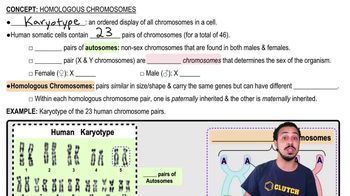
Homologous Chromosomes

Stages of Mitosis

Mitosis is divided into distinct stages: prophase, metaphase, anaphase, and telophase. During prophase, chromosomes condense and the nuclear envelope breaks down. In metaphase, chromosomes align at the cell's equatorial plane. Anaphase involves the separation of sister chromatids, and in telophase, nuclear envelopes reform around the separated chromatids.
추천 영상:
가이드 코스
03:16
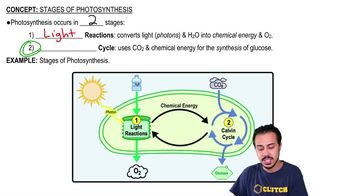
Stages of Photosynthesis

Role of Microtubules and Cytokinesis

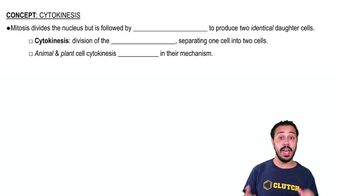
Microtubules are part of the mitotic spindle, crucial for chromosome movement during mitosis. They attach to chromosomes at the kinetochores, facilitating their alignment and separation. Cytokinesis is the process following mitosis, where the cytoplasm divides, resulting in two daughter cells. In animal cells, this involves a contractile ring that pinches the cell into two.
추천 영상: