Ch, 15 - The Chromosomal Basis of Inheritance
Campbell - Campbell Biology 12th Edition
Urry12th EditionCampbell BiologyISBN: 9785794169850당신이 사용하는 게 아니라요?교과서 변경
15장, 문제 2

Pseudohypertrophic muscular dystrophy is an inherited disorder that causes gradual deterioration of the muscles. It is seen almost exclusively in boys born to apparently unaffected parents and usually results in death in the early teens. Is this disorder caused by a dominant or a recessive allele? Is its inheritance sex-linked or autosomal? How do you know? Explain why this disorder is almost never seen in girls.

검증된 단계별 안내
1
Identify the inheritance pattern: Pseudohypertrophic muscular dystrophy primarily affects boys and is usually transmitted by unaffected mothers. This pattern suggests a sex-linked inheritance, specifically linked to the X chromosome.
Determine the type of allele: Since the disorder manifests in individuals who have only one copy of the affected gene (mostly males who have only one X chromosome), and females (with two X chromosomes) are typically carriers without showing symptoms, the allele is likely recessive.
Examine why it affects males more: Males have one X and one Y chromosome. If the X chromosome carries the recessive allele for this disorder, there is no corresponding allele on the Y chromosome to counteract it, leading to the expression of the disorder.
Understand carrier status in females: Females have two X chromosomes. Even if one X chromosome carries the recessive allele, the presence of a normal allele on the other X chromosome generally prevents the development of the disorder, making females carriers.
Explain rarity in females: For a female to exhibit symptoms of pseudohypertrophic muscular dystrophy, she must inherit the recessive allele from both parents (one from an affected or carrier father and another from a carrier mother). This scenario is much less likely, hence the disorder's rarity in girls.

비슷한 문제에 대한 검증된 영상 답변:

이 영상 해법은 위 문제에 도움이 된다고 튜터들이 추천한 것입니다.
영상 길이:
1m

주요 개념

질문에 올바르게 답하기 위해 반드시 이해해야 하는 핵심 개념들은 다음과 같습니다.

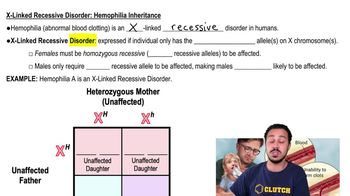
X-Linked Recessive Inheritance

Pseudohypertrophic muscular dystrophy, also known as Duchenne muscular dystrophy, is primarily caused by mutations in the dystrophin gene located on the X chromosome. This type of inheritance means that males, who have only one X chromosome, are more likely to express the disorder if they inherit the mutated allele. In contrast, females have two X chromosomes, so a mutation would need to be present on both for the disorder to manifest, making it rare in girls.
추천 영상:
04:37
X-Linked Recessive Disorder: Hemophilia Inheritance

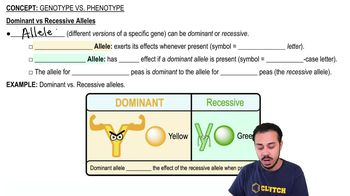
Alleles and Dominance

Alleles are different forms of a gene that can exist at a specific locus on a chromosome. In the case of pseudohypertrophic muscular dystrophy, the disorder is caused by a recessive allele. This means that an individual must inherit two copies of the recessive allele (one from each parent) to express the disorder, which is why it is predominantly seen in males who inherit the single affected X chromosome.
추천 영상:
03:39
Dominant vs. Recessive Alleles

Genetic Carrier Status

Carriers are individuals who possess one copy of a recessive allele but do not exhibit the associated phenotype. In the context of pseudohypertrophic muscular dystrophy, females can be carriers if they have one normal and one mutated X chromosome. They typically do not show symptoms because the normal allele can compensate for the defective one, allowing them to pass the mutated allele to their offspring without being affected themselves.
추천 영상:
01:28
Genetic Code
관련 실천
교과서 질문

A wild-type fruit fly (heterozygous for gray body color and red eyes) is mated with a black fruit fly with purple eyes. The offspring are wild-type, 721; black purple, 751; gray purple, 49; black red, 45. What is the recombination frequency between these genes for body color and eye color? Using information from problem 3, what fruit flies (genotypes and phenotypes) would you mate to determine the order of the body color, wing size, and eye color genes on the chromosome?

2708
views
교과서 질문

A man with hemophilia (a recessive, sex-linked condition) has a daughter without the condition. She marries a man who does not have hemophilia. What is the probability that their daughter will have hemophilia? Their son? If they have four sons, what is the probability that all will be affected?

2865
views
교과서 질문

A planet is inhabited by creatures that reproduce with the same hereditary patterns seen in humans. Three phenotypic characters are height (T=tall,t=dwart), head appendages (A=antennae,a=no antennae), and nose morphology (S=upturned snout,s=downturned snout). Since the creatures are not 'intelligent,' Earth scientists are able to do some controlled breeding experiments using various heterozygotes in testcrosses. For tall heterozygotes with antennae, the offspring are tall antennae, 46; dwarf antennae, 7; dwarf no antennae, 42; tall no antennae, 5. For heterozygotes with antennae and an upturned snout, the offspring are antennae upturned snout, 47; antennae downturned snout, 2; no antennae downturned snout, 48; no antennae upturned snout, 3. Calculate the recombination frequencies for both experiments.

1830
views