Ch. 20 - DNA Tools and Biotechnology
Campbell - Campbell Biology 12th Edition
Urry12th EditionCampbell BiologyISBN: 9785794169850당신이 사용하는 게 아니라요?교과서 변경
20장, 문제 7

Which of the following sequences in double-stranded DNA is most likely to be recognized as a cutting site for a restriction enzyme?
a. AAGG TTCC
b. GGCC CCGG
c. ACCA TGGT
d. AAAA TTTT

검증된 단계별 안내
1
Understand that restriction enzymes recognize specific sequences in DNA, often palindromic sequences, which are the same when read 5' to 3' on both strands.
Examine each option to determine if it is a palindromic sequence. A palindromic sequence reads the same forwards and backwards on complementary strands.
Option a: AAGG TTCC is not palindromic because the sequence does not read the same forwards and backwards.
Option b: GGCC CCGG is palindromic because when you read the sequence 5' to 3' on both strands, it is the same.
Option c: ACCA TGGT and option d: AAAA TTTT are not palindromic. ACCA TGGT does not read the same forwards and backwards, and AAAA TTTT, while symmetrical, is not typically recognized by restriction enzymes.

비슷한 문제에 대한 검증된 영상 답변:

이 영상 해법은 위 문제에 도움이 된다고 튜터들이 추천한 것입니다.
영상 길이:
2m

주요 개념

질문에 올바르게 답하기 위해 반드시 이해해야 하는 핵심 개념들은 다음과 같습니다.

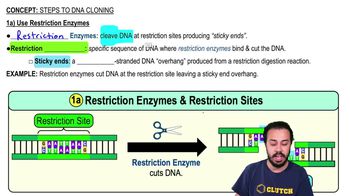
Restriction Enzymes

Restriction enzymes, also known as restriction endonucleases, are proteins that cut DNA at specific sequences. These enzymes recognize short, palindromic DNA sequences, which are the same when read forwards and backwards on complementary strands. They are essential tools in molecular biology for DNA manipulation and cloning.
추천 영상:
03:27
1a) Use Restriction Enzymes

Palindromic Sequences

A palindromic sequence in DNA is a sequence of nucleotides that reads the same in both directions on complementary strands. For example, the sequence 'GAATTC' is palindromic because its complementary strand is 'CTTAAG', which reads the same in reverse. These sequences are often recognized by restriction enzymes as cutting sites.
추천 영상:
01:03
Dideoxy Sequencing

DNA Double Helix Structure

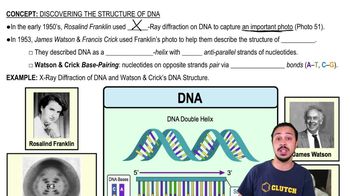
The DNA double helix consists of two complementary strands of nucleotides twisted around each other. Each strand is composed of a sugar-phosphate backbone and nitrogenous bases (adenine, thymine, cytosine, and guanine) that pair specifically (A with T, C with G). Understanding this structure is crucial for identifying palindromic sequences and restriction enzyme sites.
추천 영상:
04:41
Discovering the Structure of DNA