
Ch. 21 - Genomes and Their Evolution
Campbell - Campbell Biology 12th Edition
Urry12th EditionCampbell BiologyISBN: 9785794169850당신이 사용하는 게 아니라요?교과서 변경
21장, 문제 4d

Primates and rodents diverged about 65 million years ago, and chimpanzees and humans diverged about 6 million years ago (see Figure 21.17). How many amino acid differences are there between the sequence for the mouse and the sequence for the chimpanzee, gorilla, and rhesus monkey? How many amino acid differences are there between the human se-quence and the sequence for the chimpanzee, gorilla, and rhesus monkey? Based solely on the numbers of amino acid differences occurring over these time periods, what might you hypothesize about the rate of evolution of the FOXP2gene? Based on the information in the chapter regarding the FOXP2 gene, is your hypothesis correct?

검증된 단계별 안내
1
Identify the time periods of divergence: Primates and rodents diverged 65 million years ago, while chimpanzees and humans diverged 6 million years ago.
Understand that the number of amino acid differences can be used to infer evolutionary relationships and rates of evolution. More differences typically indicate a longer time since divergence.
Compare the amino acid sequences of the FOXP2 gene between the mouse and the primates (chimpanzee, gorilla, rhesus monkey) to determine the number of differences.
Compare the amino acid sequences of the FOXP2 gene between humans and the primates (chimpanzee, gorilla, rhesus monkey) to determine the number of differences.
Hypothesize about the rate of evolution of the FOXP2 gene based on the number of amino acid differences. Consider whether the rate is consistent with the time periods of divergence and check if this aligns with known information about the FOXP2 gene's evolution.

비슷한 문제에 대한 검증된 영상 답변:

이 영상 해법은 위 문제에 도움이 된다고 튜터들이 추천한 것입니다.
영상 길이:
2m
도움이 되었나요?

주요 개념

질문에 올바르게 답하기 위해 반드시 이해해야 하는 핵심 개념들은 다음과 같습니다.

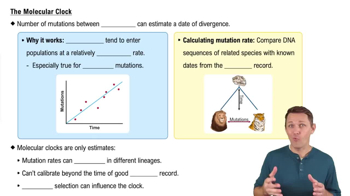
Molecular Clock Hypothesis

The molecular clock hypothesis suggests that genetic mutations accumulate at a relatively constant rate over time, allowing scientists to estimate the time of divergence between species by comparing genetic differences. This concept is crucial for understanding how the number of amino acid differences can be used to infer evolutionary timelines and rates of evolution.
추천 영상:
가이드 코스
05:13
The Molecular Clock

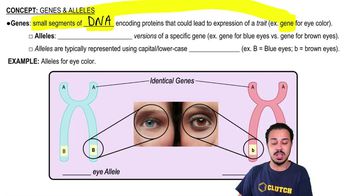
FOXP2 Gene

The FOXP2 gene is known for its role in speech and language development in humans. It is highly conserved across species, meaning it has undergone few changes over time. Understanding the function and evolutionary history of the FOXP2 gene is essential for hypothesizing about its rate of evolution and comparing it across different species, such as primates and rodents.
추천 영상:
05:02
Genes & Alleles

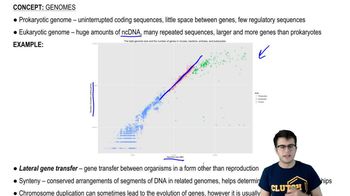
Comparative Genomics

Comparative genomics involves comparing the genomes of different species to understand their evolutionary relationships and functional biology. By analyzing amino acid differences in the FOXP2 gene among species like mice, chimpanzees, gorillas, and rhesus monkeys, researchers can draw conclusions about evolutionary rates and the genetic basis of species-specific traits.
추천 영상:
05:30
Genomes and Genome Evolution