
Ch. 26 - Phylogeny and the Tree of Life
Campbell - Campbell Biology 12th Edition
Urry12th EditionCampbell BiologyISBN: 9785794169850당신이 사용하는 게 아니라요?교과서 변경
26장, 문제 2

To apply parsimony to constructing a phylogenetic tree
a. Choose the tree that assumes all evolutionary changes are equally probable
b. Choose the tree in which the branch points are based on as many shared derived characters as possible
c. Choose the tree that represents the fewest evolutionary changes, in either DNA sequences or morphology
d. Choose the tree with the fewest branch points

검증된 단계별 안내
1
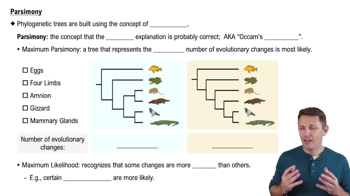
Understand the concept of parsimony in phylogenetics: Parsimony is a principle that suggests the simplest explanation or path with the least number of steps is preferred. In the context of phylogenetic trees, it means choosing the tree that requires the fewest evolutionary changes.
Identify the key elements of the problem: The problem is asking which criterion should be used to apply parsimony when constructing a phylogenetic tree.
Analyze each option provided: a) assumes all changes are equally probable, b) focuses on shared derived characters, c) represents the fewest evolutionary changes, d) has the fewest branch points.
Relate the concept of parsimony to the options: Parsimony is directly related to minimizing evolutionary changes, which aligns with option c.
Conclude that the correct application of parsimony in constructing a phylogenetic tree is to choose the tree that represents the fewest evolutionary changes, as this aligns with the principle of simplicity and minimalism in evolutionary pathways.

비슷한 문제에 대한 검증된 영상 답변:

이 영상 해법은 위 문제에 도움이 된다고 튜터들이 추천한 것입니다.
영상 길이:
50s
도움이 되었나요?

주요 개념

질문에 올바르게 답하기 위해 반드시 이해해야 하는 핵심 개념들은 다음과 같습니다.

Parsimony in Phylogenetics

Parsimony, in the context of phylogenetics, is a principle that suggests the simplest explanation or path with the least number of changes is preferred. When constructing phylogenetic trees, parsimony aims to minimize the total number of evolutionary changes, such as mutations or trait modifications, required to explain the observed data. This approach helps in hypothesizing the most likely evolutionary relationships among species.
추천 영상:

Phylogenetic Tree

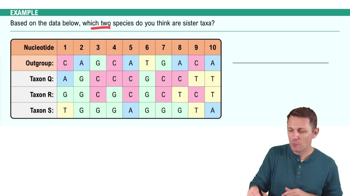
A phylogenetic tree is a diagram that represents the evolutionary relationships among various biological species based on similarities and differences in their physical or genetic characteristics. The tree's branches illustrate how species or other groups have diverged from common ancestors over time. Understanding the structure and interpretation of these trees is crucial for studying evolutionary biology and the history of life.
추천 영상:
가이드 코스
04:13
Building Phylogenetic Trees Example 2

Shared Derived Characters

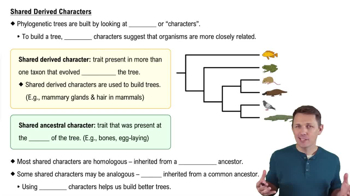
Shared derived characters, also known as synapomorphies, are traits that are present in an ancestral species and its descendants but absent in more distant relatives. These characters are crucial for determining evolutionary relationships because they provide evidence of common ancestry. In phylogenetic analysis, identifying shared derived characters helps in grouping species into clades, which are branches of the phylogenetic tree that include an ancestor and all its descendants.
추천 영상:
가이드 코스
05:42
Shared Derived Characters