Ch. 30 - Plant Diversity II: The Evolution of Seed Plants
Campbell - Campbell Biology 12th Edition
Urry12th EditionCampbell BiologyISBN: 9785794169850당신이 사용하는 게 아니라요?교과서 변경
30장, 문제 6

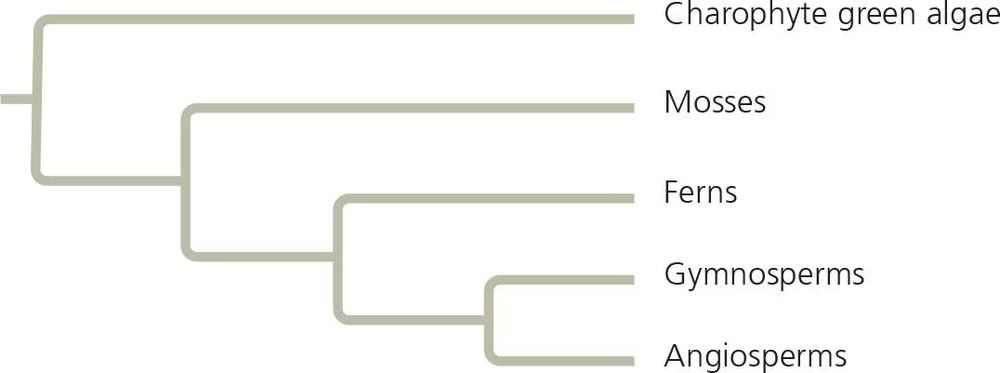
Use the letters a–d to label where on the phylogenetic tree each of the following derived characters appears.
a. Flowers
b. Embryos
c. Seeds
d. Vascular tissue
Phylogenetic tree showing evolution from charophyte green algae to mosses, ferns, gymnosperms, and angiosperms.

검증된 단계별 안내
1
Understand the concept of a phylogenetic tree: A phylogenetic tree is a diagram that represents evolutionary relationships among various biological species based on similarities and differences in their physical or genetic characteristics.
Identify the derived characters: Derived characters are traits that appear in recent parts of a lineage but not in its older members. In this problem, the derived characters are flowers, embryos, seeds, and vascular tissue.
Determine the order of appearance of these derived characters in plant evolution: Generally, embryos appear first, followed by vascular tissue, seeds, and finally flowers.
Locate the position of each derived character on the phylogenetic tree: Start from the base of the tree and move upwards, placing 'embryos' first, then 'vascular tissue', followed by 'seeds', and finally 'flowers' at the top.
Label the tree: Assign the letters a–d to each derived character based on their position in the evolutionary sequence. Ensure that 'a' corresponds to flowers, 'b' to embryos, 'c' to seeds, and 'd' to vascular tissue.

비슷한 문제에 대한 검증된 영상 답변:

이 영상 해법은 위 문제에 도움이 된다고 튜터들이 추천한 것입니다.
영상 길이:
1m

주요 개념

질문에 올바르게 답하기 위해 반드시 이해해야 하는 핵심 개념들은 다음과 같습니다.

Phylogenetic Tree

A phylogenetic tree is a diagram that represents evolutionary relationships among various biological species based on similarities and differences in their physical or genetic characteristics. It is used to illustrate the divergence of species from common ancestors, with branches indicating evolutionary paths and nodes representing common ancestors.
추천 영상:
가이드 코스
04:13
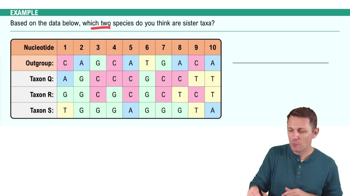
Building Phylogenetic Trees Example 2

Derived Characters

Derived characters are traits that appear in recent parts of a lineage but not in its older members. These traits are used to determine evolutionary relationships and are crucial for constructing phylogenetic trees. Derived characters help identify the point at which a particular trait evolved, marking a divergence in the evolutionary path.
추천 영상:
가이드 코스
05:42
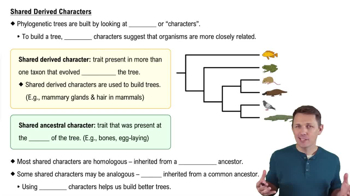
Shared Derived Characters

Evolutionary Traits in Plants

In the context of plant evolution, traits such as flowers, embryos, seeds, and vascular tissue represent significant evolutionary advancements. Flowers are reproductive structures unique to angiosperms, seeds provide protection and nourishment to plant embryos, and vascular tissue allows for efficient transport of water and nutrients, supporting plant growth and diversification.
추천 영상:
05:58
Vestigial Traits and Evolutionary Misconceptions