Ch. 50 - Sensory and Motor Mechanisms
Campbell - Campbell Biology 12th Edition
Urry12th EditionCampbell BiologyISBN: 9785794169850당신이 사용하는 게 아니라요?교과서 변경
50장, 문제 4

The human brain differentiates tastes from smells because action potentials for the two sensations differ in
a. Magnitude and shape.
b. Threshold potential.
c. Where they are received in the brain.
d. How long they take to reach the brain.

검증된 단계별 안내
1
Understand that the human brain processes different sensory inputs, such as taste and smell, through specialized regions.
Recognize that action potentials are electrical signals that transmit information from sensory receptors to the brain.
Consider that the magnitude and shape of action potentials (option A) are generally consistent for a given type of neuron and do not vary significantly between different sensory modalities.
Evaluate the threshold potential (option B), which is the minimum stimulus required to generate an action potential, and note that it is not typically the distinguishing factor for different senses.
Focus on where the action potentials are received in the brain (option C), as different sensory inputs are processed in distinct areas, such as the olfactory bulb for smell and the gustatory cortex for taste, which is the key to differentiating these sensations.

비슷한 문제에 대한 검증된 영상 답변:

이 영상 해법은 위 문제에 도움이 된다고 튜터들이 추천한 것입니다.
영상 길이:
1m
도움이 되었나요?

주요 개념

질문에 올바르게 답하기 위해 반드시 이해해야 하는 핵심 개념들은 다음과 같습니다.

Action Potentials

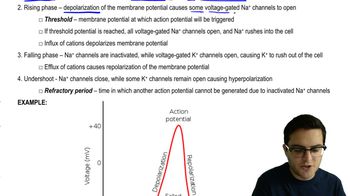
Action potentials are electrical impulses that neurons use to communicate. They are generated by the movement of ions across the neuron's membrane and have a consistent magnitude and shape. The frequency and pattern of these impulses can convey different types of information, such as distinguishing between different sensory inputs like taste and smell.
추천 영상:
09:55
Action Potential

Sensory Pathways

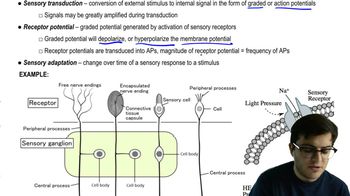
Sensory pathways are the routes taken by sensory information from the point of detection to the brain. Each sense, such as taste and smell, has distinct pathways that terminate in specific brain regions. This spatial separation in the brain allows for the differentiation of sensory inputs, as each type of sensation is processed in its dedicated area.
추천 영상:
06:25
Sensory Systems

Neural Processing in the Brain

Neural processing involves the interpretation of sensory information by the brain. Different sensory inputs are processed in specialized brain regions, such as the olfactory bulb for smell and the gustatory cortex for taste. This localization of processing helps the brain distinguish between different types of sensory information, enabling us to perceive and differentiate complex stimuli.
추천 영상:
04:19
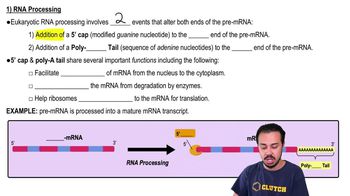
1) RNA Processing