
Ch. 53 - Population Ecology
Campbell - Campbell Biology 12th Edition
Urry12th EditionCampbell BiologyISBN: 9785794169850당신이 사용하는 게 아니라요?교과서 변경
53장, 문제 1

Population ecologists follow the fate of same-age cohorts to
a. Determine a population's carrying capacity
b. Determine the birth rate and death rate of each group in a population
c. Determine if a population is regulated by density-dependent processes
d. Determine the factors that affect the size of a population

검증된 단계별 안내
1
Understand the concept of a cohort: A cohort in population ecology refers to a group of individuals of the same age within a population. Tracking cohorts helps ecologists study population dynamics over time.
Identify the purpose of tracking cohorts: Population ecologists track cohorts to gather data on birth rates, death rates, and survival rates, which are crucial for understanding population growth and decline.
Analyze how cohort data can reveal density-dependent processes: By examining changes in birth and death rates within cohorts, ecologists can determine if these rates are influenced by population density, indicating density-dependent regulation.
Explore how cohort studies contribute to understanding carrying capacity: Cohort data can help ecologists estimate the carrying capacity, which is the maximum population size that an environment can sustain indefinitely.
Consider the broader implications of cohort studies: Tracking cohorts allows ecologists to identify various factors affecting population size, such as environmental conditions, resource availability, and predation, providing insights into population regulation mechanisms.

비슷한 문제에 대한 검증된 영상 답변:

이 영상 해법은 위 문제에 도움이 된다고 튜터들이 추천한 것입니다.
영상 길이:
2m

주요 개념

질문에 올바르게 답하기 위해 반드시 이해해야 하는 핵심 개념들은 다음과 같습니다.

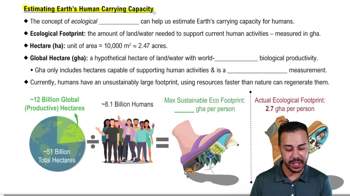
Carrying Capacity

Carrying capacity refers to the maximum number of individuals in a population that an environment can sustain indefinitely without degrading the environment. It is determined by the availability of resources such as food, water, and shelter, and is crucial for understanding population dynamics and limitations.
추천 영상:
06:24
Estimating Earth’s Human Carrying Capacity

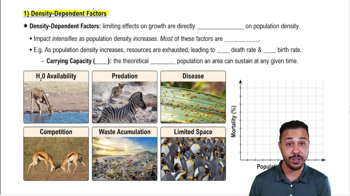
Density-Dependent Processes

Density-dependent processes are factors that affect population growth in relation to the population's density. These include competition for resources, predation, disease, and waste accumulation, which become more intense as the population size increases, thereby regulating population size and growth.
추천 영상:
02:37
Density-Dependent Factors

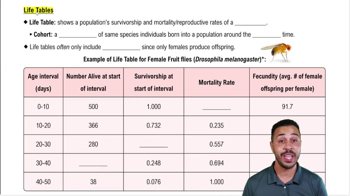
Cohort Analysis

Cohort analysis involves studying a group of individuals of the same age within a population to track their survival and reproduction rates over time. This method helps ecologists understand birth and death rates, life expectancy, and factors influencing population changes, providing insights into population dynamics and structure.
추천 영상:
03:49
Life Tables