Ch. 8 - An Introduction to Metabolism
Campbell - Campbell Biology 12th Edition
Urry12th EditionCampbell BiologyISBN: 9785794169850당신이 사용하는 게 아니라요?교과서 변경
8장, 문제 2

Most cells cannot harness heat to perform work because
a. Heat does not involve a transfer of energy.
b. Cells do not have much thermal energy; they are relatively cool.
c. Temperature is usually uniform throughout a cell.
d. Heat can never be used to do work.

검증된 단계별 안내
1
Understand the concept of energy transfer: In biological systems, energy is often transferred in forms other than heat, such as chemical energy in ATP, because heat energy is not easily harnessed for cellular work.
Consider the role of temperature in cells: Cells maintain a relatively uniform temperature, which means there is little temperature gradient to drive work processes. This uniformity limits the ability to use heat for work.
Explore the nature of heat energy: Heat energy is a form of kinetic energy that results from the movement of molecules. While it can increase the rate of reactions, it is not directly used to perform work in cells.
Evaluate the options given: Analyze each option to determine which one correctly explains why cells cannot use heat to perform work. Consider the principles of thermodynamics and energy transfer in biological systems.
Identify the correct reasoning: Recognize that the uniform temperature within cells (option c) is a key reason why heat is not used for work, as it prevents the establishment of a temperature gradient necessary for harnessing heat energy.

비슷한 문제에 대한 검증된 영상 답변:

이 영상 해법은 위 문제에 도움이 된다고 튜터들이 추천한 것입니다.
영상 길이:
50s
도움이 되었나요?

주요 개념

질문에 올바르게 답하기 위해 반드시 이해해야 하는 핵심 개념들은 다음과 같습니다.

Thermodynamics in Biological Systems

Thermodynamics involves the study of energy transfer, and in biological systems, it explains how cells convert energy from one form to another. Cells primarily use chemical energy, such as ATP, rather than heat, because heat energy is not efficiently harnessed for cellular work due to uniform temperature distribution within cells.
추천 영상:
가이드 코스
02:53
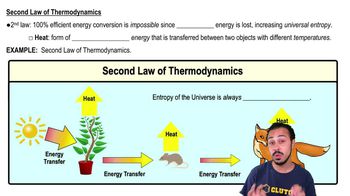
Second Law of Thermodynamics

Cellular Temperature Uniformity

Cells maintain a relatively uniform temperature, which means there is little temperature gradient to drive processes that rely on heat energy. This uniformity prevents the effective use of heat for work, as work typically requires a difference in energy levels or temperature to be performed efficiently.
추천 영상:
가이드 코스
03:39
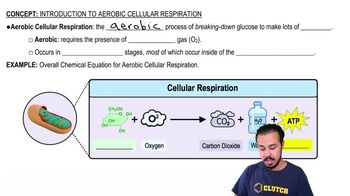
Introduction to Cellular Respiration

Energy Transfer Mechanisms

Cells rely on mechanisms like ATP hydrolysis for energy transfer, which involves chemical reactions rather than heat. These processes are more controlled and efficient for cellular functions, as they provide a direct and manageable way to harness energy for metabolic activities, unlike the diffuse nature of heat energy.
추천 영상:
가이드 코스
04:58
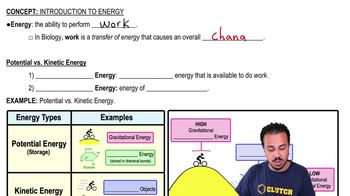
Introduction to Energy