Ch. 9 - Cellular Respiration and Fermentation
Campbell - Campbell Biology 12th Edition
Urry12th EditionCampbell BiologyISBN: 9785794169850당신이 사용하는 게 아니라요?교과서 변경
9장, 문제 10

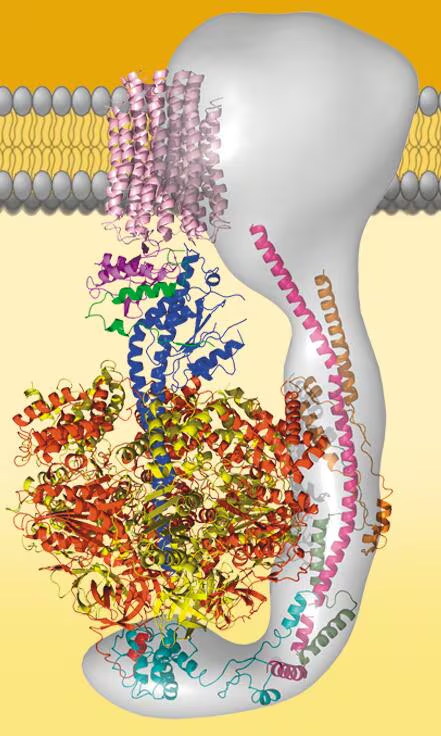
This computer model shows the four parts of ATP synthase, each part consisting of a number of polypeptide subunits (the solid gray part is still an area of active research). Using Figure 9.13 as a guide, label the rotor, stator, internal rod, and catalytic knob of this molecular motor.
Computer model of ATP synthase showing rotor, stator, internal rod, and catalytic knob with polypeptide subunits.

검증된 단계별 안내
1
Identify the ATP synthase complex in the image, which is the purple structure embedded in the membrane on the right side.
Locate the rotor, which is the part of ATP synthase that rotates as protons (H+) flow through it. In the image, this is the circular structure at the bottom of the ATP synthase complex.
Find the stator, which is the stationary part that holds the rotor in place and provides structural support. In the image, this is the part that extends from the membrane to the rotor, holding it in place.
Identify the internal rod, which connects the rotor to the catalytic knob. It is the central shaft that transmits the rotational energy from the rotor to the catalytic sites.
Locate the catalytic knob, which is the part of ATP synthase where ATP is synthesized from ADP and inorganic phosphate. In the image, this is the top part of the ATP synthase complex where the chemical reaction occurs.

비슷한 문제에 대한 검증된 영상 답변:

이 영상 해법은 위 문제에 도움이 된다고 튜터들이 추천한 것입니다.
영상 길이:
4m
도움이 되었나요?

주요 개념

질문에 올바르게 답하기 위해 반드시 이해해야 하는 핵심 개념들은 다음과 같습니다.

ATP Synthase Structure

ATP synthase is a complex enzyme found in the inner mitochondrial membrane, responsible for synthesizing ATP from ADP and inorganic phosphate. It consists of multiple subunits organized into four main parts: the rotor, stator, internal rod, and catalytic knob. The rotor and internal rod rotate as protons flow through the enzyme, while the stator and catalytic knob remain stationary, facilitating ATP production.
추천 영상:

Proton Gradient and Chemiosmosis

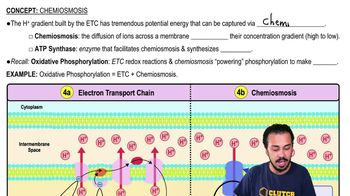
The proton gradient across the mitochondrial membrane is crucial for ATP synthesis. Protons (H+) are pumped into the intermembrane space by the electron transport chain, creating a high concentration outside the inner membrane. This gradient drives protons back through ATP synthase, a process known as chemiosmosis, providing the energy needed for ATP production as the rotor turns.
추천 영상:
05:01
Chemiosmosis

Electron Transport Chain

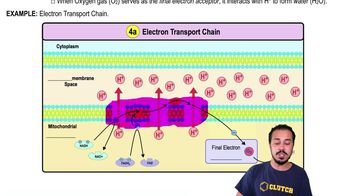
The electron transport chain (ETC) is a series of protein complexes located in the inner mitochondrial membrane. Electrons are transferred through these complexes, releasing energy used to pump protons into the intermembrane space, establishing the proton gradient. The ETC culminates in the reduction of oxygen to water, a critical step for maintaining the flow of electrons and continuous ATP production.
추천 영상:
07:41
Electron Transport Chain