
Ch. 9 - Cellular Respiration and Fermentation
Campbell - Campbell Biology 12th Edition
Urry12th EditionCampbell BiologyISBN: 9785794169850당신이 사용하는 게 아니라요?교과서 변경
9장, 문제 2

Which metabolic pathway is common to both fermentation and cellular respiration of a glucose molecule?
a. The citric acid cycle
b. The electron transport chain
c. Glycolysis
d. Reduction of pyruvate to lactate

검증된 단계별 안내
1
Begin by understanding the two processes: fermentation and cellular respiration. Both are metabolic pathways that cells use to generate energy from glucose.
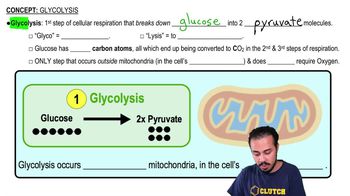
Identify the key stages of cellular respiration: glycolysis, the citric acid cycle, and the electron transport chain. Glycolysis is the first step, where glucose is broken down into pyruvate.
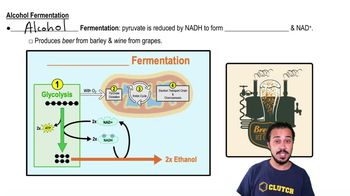
Recognize that fermentation is an anaerobic process that also begins with glycolysis, where glucose is converted into pyruvate, but does not proceed to the citric acid cycle or electron transport chain.
Note that glycolysis is the initial step in both fermentation and cellular respiration, making it common to both pathways. It occurs in the cytoplasm and does not require oxygen.
Conclude that glycolysis is the metabolic pathway shared by both fermentation and cellular respiration, as it is the process that breaks down glucose into pyruvate in both pathways.

비슷한 문제에 대한 검증된 영상 답변:

이 영상 해법은 위 문제에 도움이 된다고 튜터들이 추천한 것입니다.
영상 길이:
49s
도움이 되었나요?

주요 개념

질문에 올바르게 답하기 위해 반드시 이해해야 하는 핵심 개념들은 다음과 같습니다.

Glycolysis

Glycolysis is the metabolic pathway that breaks down glucose into pyruvate, yielding ATP and NADH. It occurs in the cytoplasm and is the first step in both fermentation and cellular respiration, making it common to both processes. Glycolysis does not require oxygen, allowing it to function in anaerobic conditions.
추천 영상:

Fermentation

Fermentation is an anaerobic process that allows cells to generate energy without oxygen. It follows glycolysis and converts pyruvate into either lactic acid or ethanol, depending on the organism. This process regenerates NAD+, enabling glycolysis to continue producing ATP in the absence of oxygen.
추천 영상:
가이드 코스
02:02
Alcohol Fermentation

Cellular Respiration

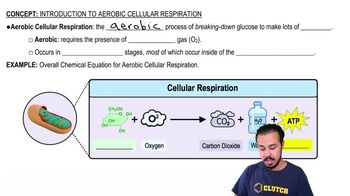
Cellular respiration is a series of metabolic processes that convert biochemical energy from nutrients into ATP, using oxygen. It includes glycolysis, the citric acid cycle, and the electron transport chain. Cellular respiration is more efficient than fermentation, producing significantly more ATP per glucose molecule.
추천 영상:
가이드 코스
03:39
Introduction to Cellular Respiration