
Ch. 29 - Plant Diversity I: How Plants Colonized Land
Campbell - Campbell Biology 11th Edition
Urry11th EditionCampbell BiologyISBN: 9789357423311당신이 사용하는 게 아니라요?교과서 변경
29장, 문제 5

Suppose an efficient conducting system evolved in a moss that could transport water and other materials as high as a tall tree. Which of the following statements about 'trees' of such a species would not be true?
a. Spore dispersal distances would probably increase.
b. Females could produce only one archegonium.
c. Unless its body parts were strengthened, such a 'tree' would probably flop over.
d. Individuals would probably compete more effectively for access to light.

검증된 단계별 안내
1
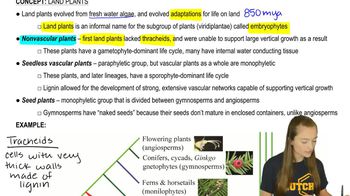
Step 1: Understand the basic biology of mosses. Mosses are non-vascular plants, meaning they lack specialized structures like xylem and phloem for transporting water and nutrients over long distances. They typically grow close to the ground and rely on diffusion for movement of substances.
Step 2: Consider the implications of a moss evolving an efficient conducting system. If a moss could transport water and nutrients as efficiently as vascular plants, it could potentially grow much taller, similar to trees.
Step 3: Analyze each statement in the context of a moss with tree-like characteristics. For statement (a), taller mosses could disperse spores over greater distances due to increased height, which is likely true.
Step 4: Evaluate statement (b). In typical mosses, females can produce multiple archegonia. The ability to produce only one archegonium is not directly related to the height or conducting system, making this statement potentially false.
Step 5: Consider statements (c) and (d). For statement (c), without structural support, a tall moss would likely flop over, which is true. For statement (d), taller mosses would have better access to light, enhancing their competitive ability, which is also true.

비슷한 문제에 대한 검증된 영상 답변:

이 영상 해법은 위 문제에 도움이 된다고 튜터들이 추천한 것입니다.
영상 길이:
2m
도움이 되었나요?

주요 개념

질문에 올바르게 답하기 위해 반드시 이해해야 하는 핵심 개념들은 다음과 같습니다.

Conducting System in Plants

A conducting system in plants, such as xylem and phloem, is essential for transporting water, nutrients, and sugars throughout the plant. In mosses, which typically lack such systems, the evolution of an efficient conducting system would allow them to grow taller and potentially resemble trees, enhancing their ability to transport materials over greater distances.
추천 영상:
12:33
Land Plants

Spore Dispersal in Mosses

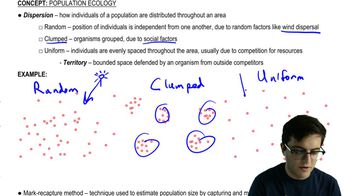
Spore dispersal is a critical reproductive strategy for mosses, relying on wind or water to spread spores to new locations. If mosses evolved to grow as tall as trees, their spores could be dispersed over greater distances due to increased height, potentially expanding their habitat range and improving reproductive success.
추천 영상:
03:20
Dispersion

Structural Support in Tall Plants

Tall plants require structural support to maintain their upright position and resist environmental forces like wind. This support is typically provided by lignin in vascular plants. Without adequate strengthening, a tall moss 'tree' would likely collapse, highlighting the importance of structural adaptations in the evolution of tall plant forms.
추천 영상:
12:33
Land Plants