Ch. 34 - The Origin and Evolution of Vertebrates
Campbell - Campbell Biology 11th Edition
Urry11th EditionCampbell BiologyISBN: 9789357423311당신이 사용하는 게 아니라요?교과서 변경
34장, 문제 4

Which clade does not include humans?
a. Synapsids
b. Lobe-fins
c. Diapsids
d. Osteichthyans

검증된 단계별 안내
1
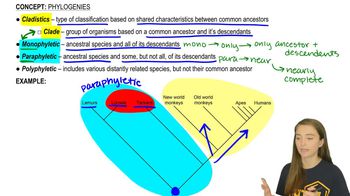
Understand the concept of clades: A clade is a group of organisms that includes a common ancestor and all its descendants. Clades are used in phylogenetics to show evolutionary relationships.
Identify the clades mentioned in the problem: synapsids, lobe-fins, diapsids, and osteichthyans.
Recall the evolutionary lineage of humans: Humans belong to the clade of synapsids, which includes mammals and their ancestors.
Examine the clade of lobe-fins: Lobe-fins include tetrapods, which are vertebrates with limbs, and humans are part of this clade.
Consider the clade of diapsids: Diapsids are a group of reptiles that include birds, crocodiles, and lizards. Humans are not part of this clade.

비슷한 문제에 대한 검증된 영상 답변:

이 영상 해법은 위 문제에 도움이 된다고 튜터들이 추천한 것입니다.
영상 길이:
27s
도움이 되었나요?

주요 개념

질문에 올바르게 답하기 위해 반드시 이해해야 하는 핵심 개념들은 다음과 같습니다.

Clade

A clade is a group of organisms that includes a common ancestor and all its descendants, representing a single branch on the tree of life. Understanding clades helps in tracing evolutionary relationships and determining which organisms share a common lineage.
추천 영상:
15:46
Cladistics

Synapsids

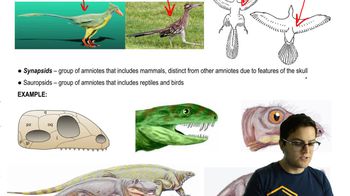
Synapsids are a clade of animals that includes mammals and their extinct relatives. They are characterized by having a single temporal opening in the skull. Humans, as mammals, are part of the synapsid clade, which is crucial for understanding our evolutionary history.
추천 영상:
04:14
Birds and Synapsids

Diapsids

Diapsids are a clade of reptiles that have two temporal openings in their skulls. This group includes most reptiles and birds, but not mammals. Understanding diapsids is essential for identifying clades that do not include humans, as humans belong to the synapsid clade.
관련 실천
교과서 질문

As hominins diverged from other primates, which of the following appeared first?

a. Reduced jawbones

b. An enlarged brain

c. The making of stone tools

d. Bipedal locomotion

788
views
교과서 질문

Living vertebrates can be divided into two major clades. Select the appropriate pair.

a. The chordates and the tetrapods

b. The urochordates and the cephalochordates

c. The cyclostomes and the gnathostome

d. The marsupials and the eutherians

1224
views
1
rank
교과서 질문

Vertebrates and tunicates share

a. Jaws adapted for feeding

b. A high degree of cephalization

c. An endoskeleton that includes a skull

d. A notochord and a dorsal, hollow nerve cord

1949
views
교과서 질문

Living members of a vertebrate lineage can be very different from early members of the lineage, and evolutionary reversals (character losses) are common. Give examples that illustrate these observations, and explain their evolutionary causes.

1144
views
교과서 질문

Which of the following could be considered the most recent common ancestor of living tetrapods?

a. A sturdy-finned, shallow-water lobe-fin whose appendages had skeletal supports similar to those of terrestrial vertebrates

b. An armored, jawed placoderm with two pairs of appendages

c. An early ray-finned fish that developed bony skeletal supports in its paired fins

d. A salamander that had legs supported by a bony skeleton but moved with the side-to-side bending typical of fishes

1039
views
교과서 질문

Unlike eutherians, both monotremes and marsupials

a. Lack nipples

b. Have some embryonic development outside the uterus

c. Lay eggs

d. Are found in Australia and Africa

1357
views