Ch. 53 - Population Ecology
Campbell - Campbell Biology 11th Edition
Urry11th EditionCampbell BiologyISBN: 9789357423311당신이 사용하는 게 아니라요?교과서 변경
53장, 문제 8

During exponential growth, a population always
a. Has a constant per capita population growth rate
b. Quickly reaches its carrying capacity
c. Cycles through time
d. Loses some individuals to emigration

검증된 단계별 안내
1
Understand the concept of exponential growth: Exponential growth occurs when the growth rate of a population is proportional to its current size, leading to the population increasing at a constant rate over time.
Identify the characteristics of exponential growth: In exponential growth, the per capita growth rate remains constant, meaning each individual contributes equally to the growth of the population.
Evaluate option a: A constant per capita population growth rate is a defining feature of exponential growth, as the rate does not change as the population size increases.
Consider option b: Exponential growth does not involve reaching carrying capacity quickly; instead, it describes the phase before any limiting factors affect the growth rate.
Analyze options c and d: Exponential growth does not involve cycles through time or losses due to emigration, as it assumes ideal conditions without external factors affecting the population size.

비슷한 문제에 대한 검증된 영상 답변:

이 영상 해법은 위 문제에 도움이 된다고 튜터들이 추천한 것입니다.
영상 길이:
1m
도움이 되었나요?

주요 개념

질문에 올바르게 답하기 위해 반드시 이해해야 하는 핵심 개념들은 다음과 같습니다.

Exponential Growth

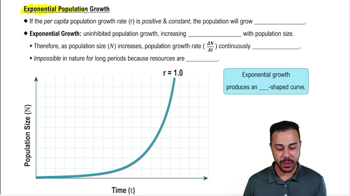
Exponential growth refers to a population increase where the rate of growth is proportional to the current size, leading to a rapid rise in numbers. This occurs when resources are abundant, and there are no significant constraints, resulting in a constant per capita growth rate. It is characterized by a J-shaped curve when plotted over time.
추천 영상:
03:05
Exponential Population Growth

Carrying Capacity

Carrying capacity is the maximum population size that an environment can sustain indefinitely, given the available resources such as food, habitat, water, and other necessities. Once a population reaches its carrying capacity, growth slows down or stops due to limited resources, leading to a stable equilibrium or logistic growth pattern.
추천 영상:
06:24
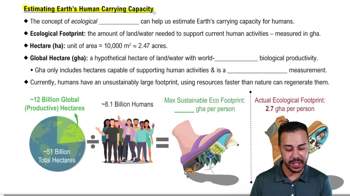
Estimating Earth’s Human Carrying Capacity

Per Capita Growth Rate

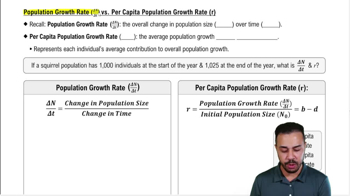
Per capita growth rate is the average contribution of each individual to the population's growth rate. In exponential growth, this rate remains constant, meaning each individual contributes equally to the population increase. It is a crucial factor in determining how quickly a population can grow under ideal conditions.
추천 영상:
03:26
Population Growth Rate vs. Per Capita Population Growth Rate
관련 실천
교과서 질문

Based on current growth rates, Earth's human population in 2019 will be closest to

a. 2.5 million

b. 4.5 billion

c. 7.5 billion

d. 10.5 billion

1250
views

교과서 질문

The observation that members of a population are uniformly distributed suggests that

a. Resources are distributed unevenly.

b. The members of the population are competing for access to a resource.

c. The members of the population are neither attracted to nor repelled by one another.

d. The density of the population is low.

1248
views
교과서 질문

Which of the following statements about human populations in industrialized countries is incorrect?

a. Birth rates and death rates are high.

b. Average family size is relatively small.

c. The population has undergone the demographic transition.

d. The survivorship curve is Type I.

1317
views
교과서 질문

According to the logistic growth equation


dNdt=rN(KN)K\(\frac{dN}{dt}\)=rN\(\frac{\left(K-N\right)}{K}\)


a. The number of individuals added per unit time is greatest when N is close to zero.

b. The per capita population growth rate increases as N approaches K.

c. Population growth is zero when N equals K.

d. The population grows exponentially when K is small.

4218
views
교과서 질문

Which of the following statements about human populations in industrialized countries is correct?

a. Birth rates and death rates are high

b. Average family size is relatively large

c. The population has undergone the demographic transition

d. The survivorship curve is Type II

1685
views