
Ch. 16 - How Genes Work
Freeman - Biological Science 8th Edition
Freeman8th EditionBiological ScienceISBN: 9780138276263당신이 사용하는 게 아니라요?교과서 변경
16장, 문제 9b

Draw a hypothetical metabolic pathway in Neurospora crassa composed of five substrates, five enzymes, and a product called nirvana. Number the substrates 1–5, and label the enzymes A–E, in order. (For instance, enzyme A catalyzes the reaction between substrates 1 and 2.)
(b) Suppose a mutant strain can survive if substrate 5 is added to the growth medium, but it cannot grow if substrates 1, 2, 3, or 4 are added. Which enzyme in the pathway is affected in this mutant?

검증된 단계별 안내
1
Begin by understanding the concept of a metabolic pathway. A metabolic pathway is a series of chemical reactions occurring within a cell, where each step is facilitated by a specific enzyme. In this problem, you need to create a pathway with five substrates and five enzymes leading to a final product called nirvana.
Draw the pathway: Start with substrate 1, which is converted to substrate 2 by enzyme A. Then, substrate 2 is converted to substrate 3 by enzyme B. Continue this pattern, where substrate 3 is converted to substrate 4 by enzyme C, substrate 4 is converted to substrate 5 by enzyme D, and finally, substrate 5 is converted to the product nirvana by enzyme E.
Label each part of the pathway: Assign numbers to the substrates (1 to 5) and letters to the enzymes (A to E). Ensure that enzyme A catalyzes the reaction between substrates 1 and 2, enzyme B between substrates 2 and 3, and so on, until enzyme E catalyzes the conversion of substrate 5 to nirvana.
Analyze the mutant strain scenario: The mutant strain can survive only if substrate 5 is added, indicating that the conversion from substrate 4 to substrate 5 is not occurring naturally. This suggests that enzyme D, which catalyzes the conversion of substrate 4 to substrate 5, is affected in the mutant strain.
Conclude the analysis: Since the mutant strain cannot grow with substrates 1, 2, 3, or 4, but can grow with substrate 5, enzyme D is likely non-functional or absent in the mutant strain, preventing the conversion of substrate 4 to substrate 5.

비슷한 문제에 대한 검증된 영상 답변:

이 영상 해법은 위 문제에 도움이 된다고 튜터들이 추천한 것입니다.
영상 길이:
2m
도움이 되었나요?

주요 개념

질문에 올바르게 답하기 위해 반드시 이해해야 하는 핵심 개념들은 다음과 같습니다.

Metabolic Pathway

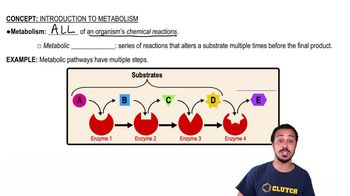
A metabolic pathway is a series of chemical reactions occurring within a cell, where each step is facilitated by a specific enzyme. These pathways convert substrates through intermediate steps into a final product, playing a crucial role in maintaining cellular functions and energy production.
추천 영상:
가이드 코스
02:17
Introduction to Metabolism

Enzyme Function

Enzymes are biological catalysts that speed up chemical reactions in metabolic pathways without being consumed. Each enzyme is specific to a particular reaction, facilitating the conversion of substrates into products. In the context of the question, enzymes A-E catalyze sequential reactions between substrates 1-5 to produce the final product, nirvana.
추천 영상:
가이드 코스
02:32
Functions of Enzymes

Mutant Strain Analysis

Analyzing mutant strains involves understanding how genetic mutations affect metabolic pathways. In the given scenario, the mutant strain's inability to grow with substrates 1-4 suggests a disruption in the pathway before substrate 5. This indicates that the enzyme responsible for converting substrate 4 to 5 is likely defective, preventing the completion of the pathway.
추천 영상:
가이드 코스
08:56
The Griffith Experiment
관련 실천
교과서 질문

Which of the following describes mutations? Select True or False for each statement.

T/F Point mutations can occur in any DNA sequence.

T/F Frameshift mutations can occur in any DNA sequence.

T/F Neutral mutations depend on the degeneracy of the genetic code.

T/F Deleterious mutations occur only in protein-coding sequences of DNA.

810
views
교과서 질문

Investigators examined the expression of transporter mRNA and protein produced in zebrafish homozygous for each of the alleles and obtained the results summarized here (+=present,−=absent). Does the allele associated with light color appear to be altering transcription ortranslation? Why?

629
views
교과서 질문

Skin color is often one of the first traits people notice in each other. Studies in zebrafish uncovered a mutation that altered a transport protein and resulted in light-colored fish. This discovery led to the finding that the same gene in humans has a strong influence on skin pigmentation in many populations. The zebrafish mutation that reduced coloration created a null allele of the transport protein gene. Which of the following types of mutation would be most likely to create this null allele?

a. A missense mutation

b. A frameshift mutation

c. A neutral mutation

d. A silent mutation

597
views
교과서 질문

One of the possibilities considered about the genetic code was that the code was overlapping, meaning that a single base could be part of up to three codons. How many amino acids would be encoded in the sequence 5′-AUGUUACGGAAU-3′ by a non-overlapping and a maximally overlapping triplet code?

a. 4 (non-overlapping) and 16 (overlapping)

b. 4 and 12

c. 4 and 10

d. 12 and 4

1686
views
교과서 질문

Draw a hypothetical metabolic pathway in Neurospora crassa composed of five substrates, five enzymes, and a product called nirvana. Number the substrates 1–5, and label the enzymes A–E, in order. (For instance, enzyme A catalyzes the reaction between substrates 1 and 2.)

(a) Suppose a mutation made the gene for enzyme C nonfunctional. What molecule would accumulate in the affected cells?

1000
views
교과서 질문

Explain what's wrong with this statement: All point mutations change the genotype and the phenotype.

907
views