DNA's primary structure is made up of just four different bases, and its secondary structure is regular and highly stable. How can a molecule with these characteristics hold the information required to build and maintain a cell?
Ch. 16 - How Genes Work
16장, 문제 1
If a base-pair change occurs in DNA, this a. is a mutation. b. would be a mutation only if it falls in a protein-coding part of a gene. c. would be a mutation only if it falls in a transcribed part of the genome. d. is not a mutation, because only one base pair has been altered.
검증된 단계별 안내1
Understand the definition of a mutation: A mutation is any change in the nucleotide sequence of DNA, regardless of where it occurs in the genome.
Recognize that a base-pair change in DNA qualifies as a mutation because it alters the genetic material, even if only one base pair is affected.
Clarify that mutations can occur anywhere in the genome, not just in protein-coding or transcribed regions. However, the impact of the mutation may vary depending on its location.
Evaluate the options provided in the question: Option (a) correctly identifies that a base-pair change is a mutation. Options (b), (c), and (d) incorrectly limit the definition of a mutation or dismiss the change entirely.
Conclude that the correct answer is (a), as a base-pair change in DNA is universally considered a mutation, regardless of its location or functional significance.

비슷한 문제에 대한 검증된 영상 답변:
이 영상 해법은 위 문제에 도움이 된다고 튜터들이 추천한 것입니다.
영상 길이:
50s도움이 되었나요?
주요 개념
질문에 올바르게 답하기 위해 반드시 이해해야 하는 핵심 개념들은 다음과 같습니다.
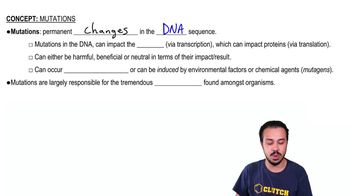
Mutation
A mutation is a permanent alteration in the DNA sequence that makes up a gene. Mutations can occur due to various factors, including environmental influences or errors during DNA replication. They can affect a single base pair or larger segments of DNA, and their consequences can range from benign to significant, potentially leading to diseases or phenotypic changes.
추천 영상:
가이드 코스
Mutations
Protein-Coding Genes
Protein-coding genes are segments of DNA that contain the instructions for synthesizing proteins. These genes are transcribed into messenger RNA (mRNA), which is then translated into a specific protein. Mutations in protein-coding regions can lead to changes in the amino acid sequence of proteins, potentially altering their function and impacting the organism's phenotype.
추천 영상:
가이드 코스
Genetic Code
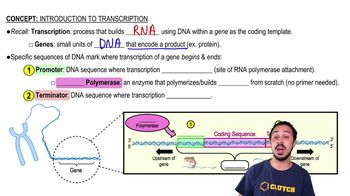
Transcription and Transcribed Regions
Transcription is the process by which the information in a gene's DNA is copied into mRNA. Transcribed regions include not only protein-coding sequences but also non-coding regions that may play regulatory roles. Mutations in these areas can influence gene expression and function, even if they do not directly alter the protein product.
추천 영상:
가이드 코스
Introduction to Transcription
관련 실천
교과서 질문
1524
views
교과서 질문
Which of the following describes the experimental strategy that was used to decipher the genetic code?
a. Comparing the amino acid sequences of proteins with the base sequence of their genes
b. Analyzing the sequence of RNAs produced from known DNA sequences
c. Analyzing mutants that changed the code
d. Examining the polypeptides produced when RNAs with particular sequences were translated
966
views
교과서 질문
Which of the following is an important exception to the central dogma of molecular biology?
a. Many genes code for RNAs that function directly in the cell.
b. DNA is the repository of genetic information in all cells.
c. Messenger RNA is a short-lived 'information carrier.
d. Proteins are responsible for most aspects of the phenotype.
3177
views