Ch. 17 - Transcription, RNA Processing, and Translation
Freeman - Biological Science 8th Edition
Freeman8th EditionBiological ScienceISBN: 9780138276263당신이 사용하는 게 아니라요?교과서 변경
17장, 문제 6

For each of these statements about the genetic code, select True or False.
a. T/F Wobble pairing accounts for the redundancy of the genetic code.
b. T/F There are 64 different tRNAs that read the 64 possible codons.
c. T/F All possible codons are used, but not all codons specify an amino acid.
d. T/F Some codons are recognized by proteins, not by tRNAs.

검증된 단계별 안내
1
Understand the concept of wobble pairing: Wobble pairing refers to the flexibility in base-pairing rules at the third position of a codon, allowing some tRNAs to recognize multiple codons. This contributes to the redundancy of the genetic code, where multiple codons can code for the same amino acid.
Analyze the statement about the number of tRNAs: There are 64 possible codons (4 bases^3 positions), but not all codons require a unique tRNA. Due to wobble pairing, fewer than 64 tRNAs are needed to read all codons.
Evaluate the statement about codon usage: All 64 codons are used in the genetic code, but not all codons specify an amino acid. For example, stop codons (e.g., UAA, UAG, UGA) signal the termination of translation and do not code for amino acids.
Examine the statement about codons recognized by proteins: Some codons, such as stop codons, are not recognized by tRNAs but are instead recognized by release factors, which are proteins that terminate translation.
For each statement, apply the relevant biological concept to determine whether it is true or false based on the explanations provided in the previous steps.

비슷한 문제에 대한 검증된 영상 답변:

이 영상 해법은 위 문제에 도움이 된다고 튜터들이 추천한 것입니다.
영상 길이:
2m
도움이 되었나요?

주요 개념

질문에 올바르게 답하기 위해 반드시 이해해야 하는 핵심 개념들은 다음과 같습니다.

Wobble Pairing

Wobble pairing refers to the flexibility in base pairing between the third base of a codon and the corresponding anticodon of tRNA. This phenomenon allows a single tRNA to recognize multiple codons that code for the same amino acid, contributing to the redundancy of the genetic code. This flexibility helps to minimize the impact of mutations and ensures efficient protein synthesis.
추천 영상:
08:09
Homologous Chromosomes

tRNA and Codons

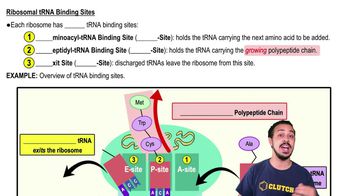
Transfer RNA (tRNA) molecules are responsible for bringing amino acids to the ribosome during protein synthesis, matching their anticodons to the corresponding codons on the mRNA. While there are 64 possible codons (combinations of three nucleotides), there are fewer than 64 distinct tRNAs due to the wobble effect, which allows some tRNAs to pair with multiple codons. This means that not every codon has a unique tRNA.
추천 영상:
06:16
Ribosomal tRNA Binding Sites

Codon Usage

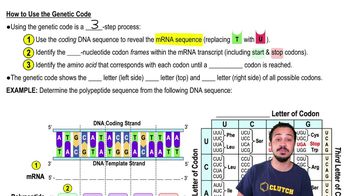
Codon usage refers to the frequency with which different codons are used to encode amino acids in a given organism. While all 64 codons exist, not all are utilized in every organism, and some codons may not specify an amino acid at all, serving instead as stop signals. Additionally, certain codons may be recognized by proteins or other molecules, highlighting the complexity of genetic translation beyond just tRNA recognition.
추천 영상:
11:39
How to Use the Genetic Code
관련 실천
교과서 질문

In a particular bacterial species, temperature-sensitive conditional mutations cause expression of a wild-type phenotype at one growth temperature and a mutant phenotype at another—typically higher—temperature. Imagine that when a bacterial cell carrying such a mutation is shifted from low to high growth temperatures, RNA polymerases in the process of elongation complete transcription normally, but no new transcripts can be started. The mutation in this strain most likely affects:

a. The terminator sequence

b. The start codon

c. Sigma

d. One of the polypeptides of the core RNA polymerase

1212
views
교과서 질문

The nucleotide shown here is called cordycepin triphosphate. It is a natural product of a fungus that is used in traditional medicines.

If cordycepin triphosphate is added to a cell-free transcription reaction, the nucleotide is added onto the growing RNA chain but then no more nucleotides can be added. Examine the structure of cordycepin and explain why it ends transcription.

1526
views
교과서 질문

In what ways are a promoter and a start codon similar? In what ways are they different?

2352
views
교과서 질문

Splicing begins:

a. As transcription occurs.

b. After transcription is complete.

c. As translation occurs.

d. After translation is complete.

1053
views
교과서 질문

Compared with mRNAs that have a cap and tail, predict what will be observed if a eukaryotic mRNA lacked a cap and poly(A) tail.

a. The primary transcript would not be processed properly.

b. Translation would occur inefficiently.

c. Enzymes on the ribosome would add a cap and poly(A) tail.

d. tRNAs would become more resistant to degradation.

1247
views
교과서 질문

RNases and proteases are enzymes that destroy RNAs and proteins, respectively. Which of the following enzymes, if added to a spliceosome, would be predicted to prevent recognition of pre-mRNA regions critical for splicing?

a. An RNase specific for tRNAs

b. An RNase specific for snRNAs

c. A protease specific for initiation factors

d. A protease specific for a release factor

1158
views