
Ch. 18 - Control of Gene Expression in Bacteria
Freeman - Biological Science 8th Edition
Freeman8th EditionBiological ScienceISBN: 9780138276263당신이 사용하는 게 아니라요?교과서 변경
18장, 문제 5

Evaluate these statements about regulation of the lac operon. Select True or False for each statement.
T/FThe lac operon is transcribed at the highest rate when extracellular glucose and lactose are abundant.
T/FThe repressor protein is bound to DNA of the operator when lactose is present.
T/FA mutation in the operator is likely to prevent transcription of the lac operon under any condition.
T/FA mutation that alters the catabolite activator protein is predicted to alter the regulation of many different operons.

검증된 단계별 안내
1
Understand the lac operon: The lac operon is a set of genes in bacteria that are involved in lactose metabolism. It is regulated by the presence or absence of lactose and glucose, as well as by the activity of regulatory proteins like the repressor and the catabolite activator protein (CAP).
Analyze the first statement: 'The lac operon is transcribed at the highest rate when extracellular glucose and lactose are abundant.' Recall that glucose inhibits the activity of CAP, which is necessary for high transcription rates of the lac operon. Therefore, transcription is not at its highest when glucose is abundant, even if lactose is present.
Analyze the second statement: 'The repressor protein is bound to DNA of the operator when lactose is present.' Remember that lactose (or its isomer allolactose) binds to the repressor protein, causing it to change shape and release from the operator. This allows transcription to proceed. Thus, the repressor is not bound to the operator when lactose is present.
Analyze the third statement: 'A mutation in the operator is likely to prevent transcription of the lac operon under any condition.' Consider that a mutation in the operator could either prevent the repressor from binding (leading to constant transcription) or disrupt the operator's function entirely, which might prevent transcription. The specific effect depends on the nature of the mutation.
Analyze the fourth statement: 'A mutation that alters the catabolite activator protein is predicted to alter the regulation of many different operons.' Recall that CAP is a global regulatory protein that affects the transcription of multiple operons, not just the lac operon. A mutation in CAP would likely impact the regulation of many operons that rely on CAP for activation.

비슷한 문제에 대한 검증된 영상 답변:

이 영상 해법은 위 문제에 도움이 된다고 튜터들이 추천한 것입니다.
영상 길이:
2m

주요 개념

질문에 올바르게 답하기 위해 반드시 이해해야 하는 핵심 개념들은 다음과 같습니다.

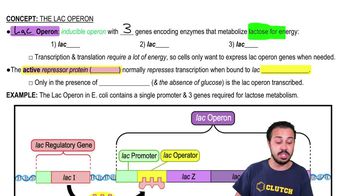
Lac Operon Structure and Function

The lac operon is a set of genes in E. coli that are involved in the metabolism of lactose. It consists of three structural genes (lacZ, lacY, and lacA) and regulatory elements, including a promoter and an operator. The operon is regulated by the presence of lactose and glucose, allowing the bacteria to efficiently utilize available sugars.
추천 영상:
07:06
The Lac Operon

Repressor Protein and Induction

The repressor protein binds to the operator region of the lac operon, preventing transcription when lactose is absent. When lactose is present, it binds to the repressor, causing a conformational change that releases the repressor from the operator, thus allowing transcription to occur. This mechanism is an example of negative regulation.
추천 영상:
02:50
Proteins

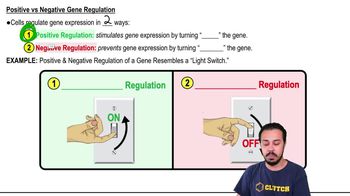
Catabolite Activator Protein (CAP) and Positive Regulation

Catabolite activator protein (CAP) is involved in the positive regulation of the lac operon. When glucose levels are low, CAP binds to cyclic AMP (cAMP) and then to the promoter of the lac operon, enhancing RNA polymerase binding and increasing transcription. This mechanism ensures that the operon is activated only when lactose is available and glucose is scarce.
추천 영상:
02:17
Positive vs Negative Gene Regulation