
Ch. 18 - Control of Gene Expression in Bacteria
Freeman - Biological Science 8th Edition
Freeman8th EditionBiological ScienceISBN: 9780138276263당신이 사용하는 게 아니라요?교과서 변경
18장, 문제 10

X-gal is a colorless, lactose-like molecule that can be split into two fragments by ββ-galactosidase. One of these product molecules creates a blue color. The photograph here shows E. coli colonies growing in a medium that contains X-gal. Find three colonies whose cells have functioning copies of ββ-galactosidase.
Find three colonies whose cells might have mutations in the lacZ or the lacY genes.
Suppose you analyze the protein-coding sequence of the lacZ and lacY genes of cells from the three mutant colonies and find that these sequences are wild type (normal).
What other region of the lac operon might be altered to account for the mutant phenotype of these colonies?

검증된 단계별 안내
1
Step 1: Understand the role of X-gal and β-galactosidase. X-gal is a substrate that mimics lactose and is cleaved by the enzyme β-galactosidase. When cleaved, one of the products produces a blue color. Colonies that appear blue have functioning β-galactosidase, while white colonies may indicate a mutation in the lac operon.
Step 2: Identify colonies with functioning β-galactosidase. Look for three blue colonies on the plate, as these indicate that the cells in these colonies have active β-galactosidase and are likely expressing the lacZ gene properly.
Step 3: Identify colonies with potential mutations. Look for three white colonies, as these indicate that the cells in these colonies are not producing functional β-galactosidase. This could be due to mutations in the lacZ or lacY genes, or other regions of the lac operon.
Step 4: Analyze the protein-coding sequences of lacZ and lacY in the mutant colonies. If the sequences are wild type (normal), this suggests that the mutations are not in the coding regions of these genes. Instead, the issue may lie in regulatory regions of the lac operon.
Step 5: Consider other regions of the lac operon that could be altered. The mutation might be in the promoter region (where RNA polymerase binds), the operator region (where the repressor binds), or in the gene encoding the repressor protein (lacI). These mutations could prevent proper transcription or regulation of the lacZ and lacY genes, leading to the observed mutant phenotype.

비슷한 문제에 대한 검증된 영상 답변:

이 영상 해법은 위 문제에 도움이 된다고 튜터들이 추천한 것입니다.
영상 길이:
2m
도움이 되었나요?

주요 개념

질문에 올바르게 답하기 위해 반드시 이해해야 하는 핵심 개념들은 다음과 같습니다.

Lac Operon

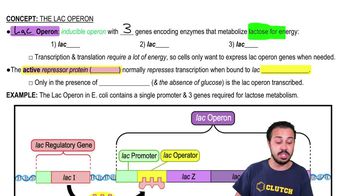
The lac operon is a set of genes in E. coli that are involved in the metabolism of lactose. It includes the genes lacZ, lacY, and lacA, which encode proteins necessary for lactose uptake and breakdown. The operon is regulated by the presence or absence of lactose, allowing the bacteria to efficiently use lactose as an energy source when available.
추천 영상:

β-galactosidase

β-galactosidase is an enzyme encoded by the lacZ gene that catalyzes the hydrolysis of lactose into glucose and galactose. It also cleaves X-gal, a synthetic substrate, producing a blue pigment as a byproduct. The presence of this enzyme is crucial for E. coli to utilize lactose, and its activity can be used as a marker for the functionality of the lac operon.

Mutations in Regulatory Regions

Mutations can occur not only in the coding regions of genes but also in regulatory regions that control gene expression. In the context of the lac operon, mutations in the promoter or operator regions can prevent the transcription of the lacZ and lacY genes, leading to a lack of β-galactosidase and lactose permease, even if the coding sequences are normal. These regulatory mutations can explain the mutant phenotype observed in the colonies.
추천 영상:
관련 실천
교과서 질문

The Hawaiian bobtail squid (Euprymna scolopes) is able to glow from luminescent Vibrio fischeri bacteria held in its light organs. As it swims at night near the ocean surface, it adjusts the amount of light visible to predators below to match the light from the stars and moon. Predators have difficulty seeing the illuminated squid against the night sky.

The bacteria glow in response to a molecule that regulates expression of genes involved in light-producing chemical reactions. The regulator controls production of the genes' mRNA. Therefore, the light-producing genes are under

a. Transcriptional control.

b. Translational control.

c. Post-translational control.

d. Negative control.

508
views
교과서 질문

IPTG is a molecule with a structure much like lactose. IPTG can be transported into cells by galactoside permease and can bind to the lac repressor protein. However, unlike lactose, IPTG is not broken down by ββ-galactosidase.

Predict what would occur to lac operon regulation if IPTG were added to E. coli growth medium containing no glucose or lactose.

829
views
교과서 질문

Explain why it makes sense for the lexA regulatory gene of the SOS regulon to be expressed constitutively.

622
views
교과서 질문

The diagram shown here is a model of the gene regulatory circuit for light production by V. fischeri cells. The lux operon contains genes for luminescence (luxCDABE) and a gene, luxI, that encodes an enzyme that catalyzes the production of an inducer. This inducer easily moves back and forth across the plasma membrane and acts as a signaling molecule. The lux operon is never completely turned off. The luxR gene codes for the activator LuxR. The inducer can bind to LuxR, and when it does, the LuxR–inducer complex can bind to a regulatory site to activate transcription of the lux operon and inhibit transcription of luxR.

Explain how this gene regulatory circuit accounts for bacteria emitting light only when they reach a high cell density.

550
views
교과서 질문

In a mutant that lacks adenylyl cyclase, the enzyme that synthesizes cAMP, predict which of the following conditions of extracellular lactose and glucose would cause regulation of the lac operon to differ from that of wild-type cells.

a. No lactose, no glucose

b. No lactose, abundant glucose

c. Abundant lactose, no glucose

d. Abundant lactose, abundant glucose

539
views
교과서 질문

The light-producing genes of V. fischeri are organized in an operon that is under positive control by an activator protein called LuxR.

Would you expect the genes of this operon to be transcribed when LuxR is bound or not bound to a DNA regulatory sequence? Explain.

589
views