
Ch. 19 - Control of Gene Expression in Eukaryotes
Freeman - Biological Science 8th Edition
Freeman8th EditionBiological ScienceISBN: 9780138276263당신이 사용하는 게 아니라요?교과서 변경
19장, 문제 7

The following statements are about the control of chromatin condensation. Select True or False for each.
T/F Reducing histone acetylase activity is likely to decrease gene transcription.
T/F Mutations that reduce the number of positively charged amino acids on histones should promote open chromatin.
T/F Chromatin remodeling complexes add chemical groups to histones.
T/F Adding an inhibitor of DNA methylation is likely to reduce gene transcription.

검증된 단계별 안내
1
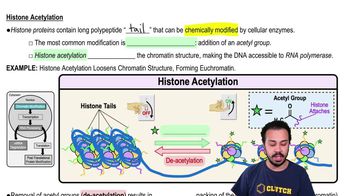
Understand the role of histone acetylation: Histone acetylation typically reduces the positive charge on histones, decreasing their affinity for DNA and promoting a more open chromatin structure, which facilitates gene transcription. Therefore, reducing histone acetylase activity would likely decrease gene transcription.
Consider the impact of mutations on histone charge: Histones are proteins that can have positively charged amino acids, which interact with the negatively charged DNA. Mutations that reduce the number of positively charged amino acids on histones would decrease their interaction with DNA, promoting a more open chromatin structure and potentially increasing gene transcription.
Evaluate the function of chromatin remodeling complexes: Chromatin remodeling complexes are involved in repositioning nucleosomes and altering chromatin structure, but they do not typically add chemical groups to histones. Instead, they facilitate access to DNA by changing the physical arrangement of chromatin.
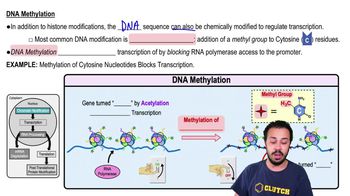
Analyze the effect of DNA methylation inhibitors: DNA methylation generally suppresses gene transcription by adding methyl groups to DNA, which can lead to a more condensed chromatin structure. Adding an inhibitor of DNA methylation would likely increase gene transcription by preventing this suppression.
Review each statement based on the explanations provided: Use the understanding of histone acetylation, histone mutations, chromatin remodeling, and DNA methylation to determine the truth value of each statement regarding chromatin condensation and gene transcription.

비슷한 문제에 대한 검증된 영상 답변:

이 영상 해법은 위 문제에 도움이 된다고 튜터들이 추천한 것입니다.
영상 길이:
35s

주요 개념

질문에 올바르게 답하기 위해 반드시 이해해야 하는 핵심 개념들은 다음과 같습니다.

Histone Acetylation

Histone acetylation involves the addition of acetyl groups to histone proteins, which reduces the positive charge on histones and decreases their affinity for negatively charged DNA. This process generally leads to a more relaxed chromatin structure, promoting gene transcription. Therefore, reducing histone acetylase activity would likely decrease gene transcription by maintaining a more condensed chromatin state.
추천 영상:
04:14
Histone Acetylation

Histone Charge and Chromatin Structure

Histones are proteins that help package DNA into chromatin, and their positive charge allows them to bind tightly to the negatively charged DNA. Mutations that reduce the number of positively charged amino acids on histones can decrease this binding affinity, leading to a more open chromatin structure. This open structure is associated with increased accessibility for transcription machinery, thus promoting gene transcription.
추천 영상:
04:14
Histone Acetylation

DNA Methylation and Gene Transcription

DNA methylation involves the addition of methyl groups to DNA, typically at cytosine bases, which can lead to a more condensed chromatin structure and reduced gene transcription. Inhibitors of DNA methylation can prevent this modification, potentially leading to a more open chromatin state and increased transcription. However, the effect can vary depending on the context and specific genes involved.
추천 영상:
03:39
DNA Methylation
관련 실천
교과서 질문

In the follow-up work to the experiment shown in Figure 19.6, the researchers used a technique that allowed them to see if two DNA sequences are in close physical proximity (association). They applied this method to examine how often an enhancer and the core promoter of the Hnf4a regulatory gene were near each other. A logical prediction is that compared with rats born to mothers fed a healthy diet, the Hnf4a gene in rats born to mothers fed a protein-poor diet would


a. Show no difference in how often the promoter and enhancer associated

b. Never show any promoter–enhancer association

c. Show a lower frequency of promoter–enhancer association

d. Show a higher frequency of promoter–enhancer association

786
views
교과서 질문

Imagine discovering a loss-of-function mutation in a eukaryotic gene. You determine the gene's nucleotide sequence from the start site for transcription to the termination point of transcription and find no differences from the wild-type sequence. Explain where you think the mutation might be and how the mutation might be acting.

726
views
교과서 질문

Compare and contrast the items in each pair:

(b) promoter-proximal elements and the operator of the lac operon

633
views
교과서 질문

Predict how a mutation that caused continuous production of active p53 would affect the cell.

837
views
교과서 질문

Compare and contrast the items in each pair:

(c) general transcription factors and sigma.

653
views
교과서 질문

Imagine repeating the experiment on epigenetic inheritance that is shown in Figure 19.6. You measure the amount of radioactive uridine (U) incorporated into Hnf4a mRNA in counts per minute (cpm) to determine the level of Hnf4a gene transcription in rats born to mothers fed either a normal diet or a low-protein diet. The results are 11,478 cpm for the normal diet and 7368 cpm for the low-protein diet. For this problem, your task is to prepare a graph similar to the one at the bottom of Figure 19.6 that shows the normalized results for the low-protein diet relative to the normal diet. Normalizing values means that the value obtained from one condition is expressed as 1.0 (the norm; the normal diet in this case) and the values obtained from any other conditions (low-protein diet in this case) are expressed as decimal values relative to the norm.

1136
views