
Ch. 2 - Water and Carbon: The Chemical Basis of Life
Freeman - Biological Science 8th Edition
Freeman8th EditionBiological ScienceISBN: 9780138276263당신이 사용하는 게 아니라요?교과서 변경
2장, 문제 7

If you were given a solution that has a pH of 8.5, what would be its concentration of protons? What is the difference in proton concentration between this solution and one that has a pH of 7?

검증된 단계별 안내
1
Understand the relationship between pH and proton concentration: pH is defined as the negative logarithm (base 10) of the hydrogen ion concentration. Mathematically, it is represented as pH = -log10[H+], where [H+] is the concentration of hydrogen ions in moles per liter.
Calculate the proton concentration for the solution with pH 8.5: Use the formula [H+] = 10^(-pH). Substituting the given pH, [H+] = 10^(-8.5) = 3.16 x 10^-9 M.
Calculate the proton concentration for the solution with pH 7: Similarly, use the formula [H+] = 10^(-pH). For pH 7, [H+] = 10^(-7) = 1 x 10^-7 M.
Determine the difference in proton concentration between the two solutions: Subtract the proton concentration of the pH 8.5 solution from that of the pH 7 solution. Difference = 1 x 10^-7 M - 3.16 x 10^-9 M = 9.684 x 10^-8 M.
Interpret the result: The solution with pH 7 has a higher proton concentration compared to the solution with pH 8.5. The difference in proton concentration is 9.684 x 10^-8 M, indicating that the pH 7 solution is more acidic.

비슷한 문제에 대한 검증된 영상 답변:

이 영상 해법은 위 문제에 도움이 된다고 튜터들이 추천한 것입니다.
영상 길이:
44s

주요 개념

질문에 올바르게 답하기 위해 반드시 이해해야 하는 핵심 개념들은 다음과 같습니다.

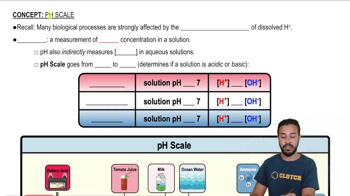
pH Scale

The pH scale measures the acidity or basicity of a solution, ranging from 0 to 14. A pH of 7 is considered neutral, values below 7 indicate acidity, and values above 7 indicate alkalinity. Each unit change in pH represents a tenfold change in hydrogen ion concentration, making it a logarithmic scale.
추천 영상:
11:05
pH Scale

Proton Concentration

Proton concentration in a solution is often expressed in terms of molarity, specifically as [H+]. The relationship between pH and proton concentration is given by the formula [H+] = 10^(-pH). Therefore, a higher pH corresponds to a lower concentration of protons, while a lower pH indicates a higher concentration.
추천 영상:
04:51
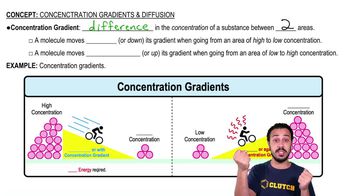
Concentration Gradients and Diffusion

Calculating Differences in Proton Concentration

To find the difference in proton concentration between two solutions with different pH values, one can calculate the [H+] for each pH using the formula mentioned above. For example, a solution with pH 8.5 has a lower proton concentration than one with pH 7, and the difference can be quantified by subtracting the two concentrations.
추천 영상:
04:51
Concentration Gradients and Diffusion
관련 실천
교과서 질문

Consider the reaction between carbon dioxide and water to form carbonic acid: CO2(g)+H2O(l)⇌CH2O3(aq) In the ocean, carbonic acid immediately dissociates to form a proton and bicarbonate ion, as follows: CH2O3(aq)+H+(aq)⇌CHO3−(aq) If an underwater volcano bubbled additional CO2 into the ocean, would this sequence of reactions be driven to the left or the right? How would this affect the pH of the ocean?

2487
views
교과서 질문

What factors determine whether a chemical reaction is spontaneous or not?

2857
views
교과서 질문

When H2 and CO2 react, acetic acid can be formed spontaneously while the production of formaldehyde requires an input of energy. Which of these conclusions can be drawn from this observation?

a. More heat is released when formaldehyde is produced compared to the production of acetic acid.

b. Compared to the reactants that it is formed from, formaldehyde has more potential energy than does acetic acid.

c. Entropy decreases when acetic acid is produced and increases when formaldehyde is produced.

d. Only acetic acid could be produced under conditions that existed in early Earth.

1947
views
교과서 질문

Which of these molecules would you predict to have the largest number of polar covalent bonds based on their molecular formulas?

a. C2H6O(ethanol)

b. C2H6(ethane)

c. C2H4O2(acetic acid)

d. C3H8O (propanol)

1462
views
교과서 질문

Locate fluorine (F) on the partial periodic table provided in Figure 2.2. Predict its relative electronegativity compared to hydrogen, sodium, and oxygen. State the number and type of bond(s) you expect it would form if it reacted with sodium (Na).

2555
views
교과서 질문

From what you have learned about water, why do coastal regions tend to have milder climates with cooler summers and warmer winters than do inland areas at the same latitude?

2373
views