교과서 질문
Explain how RNA-seq can be used to analyze patterns of gene expression.
862
views

 Freeman 8th EditionCh. 20 - The Molecular Revolution: Biotechnology, Genomics, and New Frontiers문제 4
 검증된 단계별 안내
 05:30
05:30
 06:58 05:30
Explain how RNA-seq can be used to analyze patterns of gene expression.
Consider the validity of the following statements about genome editing. Select True or False for each statement.
T/FCas proteins work as endonucleases.
T/FsgRNA is used by bacterial cells to detect which DNA to cut.
T/FHomologous recombination is always used to join pieces of broken DNA.
T/FIt is possible to modify genes as well as disrupt them by genome editing.
After finding a gene that causes a disease, researchers often introduce the defective allele into mice to create an animal model of the disease. Why are these models valuable?
a. They allow the testing of potential drug therapies without endangering human patients.
b. They allow the sequencing of the mutant allele.
c. They allow the production of large quantities of the defective gene product, usually a protein.
d. They allow the study of how the gene was transmitted from parents to offspring.
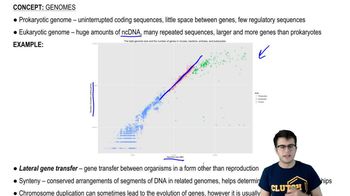
Gene density is the number of genes per million base pairs (Mbp). Using Figure 20.5b, find the approximate number of genes estimated in water fleas and in humans, and note the size of each genome. Calculate the gene density in water fleas relative to that in humans.