
Ch. 21 - Genes, Development, and Evolution
Freeman - Biological Science 8th Edition
Freeman8th EditionBiological ScienceISBN: 9780138276263당신이 사용하는 게 아니라요?교과서 변경
21장, 문제 7

What is the connection between genetic regulatory cascades and the observation that differentiation is a step-by-step process?

검증된 단계별 안내
1
Understand that genetic regulatory cascades are sequences of gene activations where one gene's product regulates the expression of another gene, creating a chain reaction.
Recognize that differentiation is the process by which a less specialized cell becomes a more specialized cell type, often involving changes in gene expression.
Connect the two concepts by noting that genetic regulatory cascades provide a mechanism for the orderly and sequential activation of genes necessary for differentiation.
Consider how each step in a genetic regulatory cascade can correspond to a specific stage in the differentiation process, ensuring that cells acquire the correct identity and function.
Reflect on how disruptions in these cascades can lead to incomplete or incorrect differentiation, highlighting the importance of precise regulation in developmental biology.

비슷한 문제에 대한 검증된 영상 답변:

이 영상 해법은 위 문제에 도움이 된다고 튜터들이 추천한 것입니다.
영상 길이:
2m
도움이 되었나요?

주요 개념

질문에 올바르게 답하기 위해 반드시 이해해야 하는 핵심 개념들은 다음과 같습니다.

Genetic Regulatory Cascades

Genetic regulatory cascades refer to a series of molecular events where one gene product activates or represses the expression of other genes, leading to a sequential activation of gene networks. These cascades are crucial in developmental biology, as they control the timing and order of gene expression necessary for cellular differentiation and development.
추천 영상:
가이드 코스
02:35
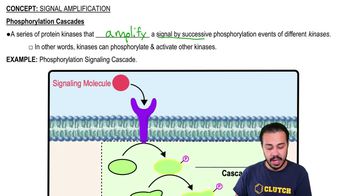
Phosphorylation Cascades

Cellular Differentiation

Cellular differentiation is the process by which a less specialized cell becomes a more specialized cell type, acquiring distinct structural and functional characteristics. This process is guided by genetic regulatory cascades, ensuring that cells develop specific functions in a step-by-step manner, crucial for forming complex tissues and organs.
추천 영상:
가이드 코스
03:39
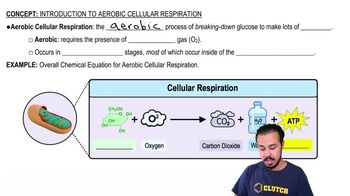
Introduction to Cellular Respiration

Step-by-Step Process in Differentiation

The step-by-step process in differentiation refers to the sequential and orderly progression of cellular changes driven by genetic regulatory cascades. Each step involves specific gene expression changes that gradually lead to the specialization of cells, ensuring precise development and function of tissues, highlighting the importance of timing and sequence in developmental biology.
추천 영상:
가이드 코스
04:39
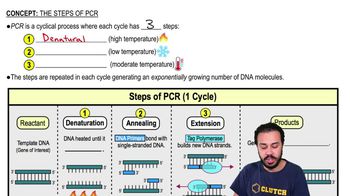
The Steps of PCR
관련 실천
교과서 질문

Which of the following provides the strongest evidence for the conservation of tool-kit genes?

a. Bicoid moved from one fly embryo into the posterior of another fly embryo causes the formation of two head regions.

b. Mutation of an unrelated gene in another species of fly has a similar effect to mutation of bicoid in Drosophila.

c. A mouse Hox gene can be used to take over the function of a mutated Drosophila Hox gene.

d. Sheep can be cloned by fusing a differentiated adult cell with an enucleated egg.

567
views
교과서 질문

Some stickleback fish develop protective spines, and other stickleback fish are spineless. Spine development is controlled by the expression of a gene known as Pitx1. The spineless phenotype is due to a mutation in Pitx1 that results in no expression of Pitx1 during development in regions where spines would otherwise form. When scientists compared the Pitx1 coding sequence in spined and spineless fish, they found this sequence was the same in both types of fish. Propose plausible hypotheses for the location of this mutation and for how it alters spine development.

662
views
교과서 질문

A tool-kit gene is               .

769
views
교과서 질문

The following predictions ask you to consider how genetic regulatory cascades provide positional information. Select True or False for each statement.

T/F Mutation of a gene at one level of a regulatory cascade will affect the expression of genes at all levels of the cascade.

T/F Mutation of a gene that is expressed later in a regulatory cascade will affect a smaller region of the body than mutation of gene that is expressed early in the cascade.

T/F In the regulatory cascade used by Drosophila, a gene at one level of the cascade will be controlled only by genes at the level immediately above it.

T/F Genes that control the largest regions of the Drosophila embryo are not transcribed in the embryo.

667
views
교과서 질문

A friend is interested in isolating genes that are expressed solely in liver cells but only has access to skin cells. She asks you for advice on whether to start her studies. What will you say?

591
views
교과서 질문

Imagine a situation in which a morphogen has its source at the posterior end of a Drosophila embryo. Every 100 µm from the posterior pole, the morphogen concentration decreases by half. If a cell required 1/16th the amount of morphogen found at the posterior pole to form part of a leg, how far from the posterior pole would the leg form?

a. 100μm

b. 160μm

c. 400μm

d. 1600 μm

605
views