
Ch. 24 - Speciation
Freeman - Biological Science 8th Edition
Freeman8th EditionBiological ScienceISBN: 9780138276263당신이 사용하는 게 아니라요?교과서 변경
24장, 문제 7

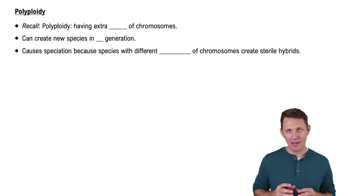
If one species (2n = 10) crosses with another species (2n = 18), producing an allopolyploid offspring, what is the ploidy of the offspring?
a. 2n = 10
b. 2n = 18
c. 2n = 10+18 = 28
d. 4n = 36 +20 = 56

검증된 단계별 안내
1
Understand the concept of allopolyploidy: Allopolyploidy occurs when two different species interbreed, resulting in offspring with a combination of the parental species' chromosome sets.
Identify the chromosome numbers of the parent species: The first species has a diploid number of 2n=10, and the second species has a diploid number of 2n=18.
Determine the chromosome contribution from each parent: In an allopolyploid, the offspring typically receives one complete set of chromosomes from each parent species.
Calculate the total chromosome number in the offspring: Add the chromosome numbers from both parent species to find the total chromosome number in the offspring.
Consider the ploidy level: Since the offspring is an allopolyploid, it will have a ploidy level that is the sum of the chromosome sets from both parents, resulting in a new diploid number.

비슷한 문제에 대한 검증된 영상 답변:

이 영상 해법은 위 문제에 도움이 된다고 튜터들이 추천한 것입니다.
영상 길이:
3m
도움이 되었나요?

주요 개념

질문에 올바르게 답하기 위해 반드시 이해해야 하는 핵심 개념들은 다음과 같습니다.

Allopolyploidy

Allopolyploidy refers to the formation of a polyploid organism through the hybridization of two different species. This process involves the combination of the complete sets of chromosomes from each parent species, resulting in offspring with a higher chromosome number than either parent. It is a common mechanism in plant evolution, leading to new species with unique genetic combinations.
추천 영상:

Chromosome Number

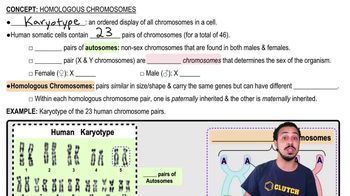
Chromosome number is the total count of chromosomes present in the nucleus of a cell. In diploid organisms, represented as 2n, chromosomes exist in pairs. When two species with different chromosome numbers cross, the resulting offspring's chromosome number is typically the sum of the two parent species' chromosome numbers, especially in cases of allopolyploidy.
추천 영상:
08:09
Homologous Chromosomes

Hybridization

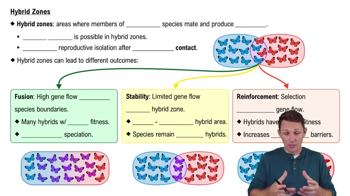
Hybridization is the process of crossing two genetically distinct species or varieties to produce offspring with traits from both parents. In the context of allopolyploidy, hybridization leads to the combination of different sets of chromosomes, creating a new organism with genetic material from both parent species. This can result in increased genetic diversity and novel characteristics in the offspring.
추천 영상:
관련 실천
교과서 질문

When the ranges of two different species meet, a stable 'hybrid zone' occupied by hybrid individuals may form. How is this possible?

a. Two diverged populations are capable of mating and producing viable and fertile offspring.

b. Hybrid individuals are always allopolyploid and are thus unable to mate with either of the original species.

c. Hybrid individuals may have reduced fitness and thus be strongly selected against.

d. One species has a selective advantage, so as hybridization continues, the other species will go extinct.

739
views
교과서 질문

True or false? Speciation is a slow process. Justify your answer.

1337
views
교과서 질문

Evaluate this statement: Gene flow increases the genetic divergence of populations.

1138
views
교과서 질문

Three-spine sticklebacks are small fish that originated in the ocean and continue to exist there, but then some took up residence in hundreds of streams and freshwater lakes in the Northern Hemisphere. Predict whether you would expect to find different species in lakes today.

787
views
교과서 질문

Sexual selection favors individuals with traits that increase their ability to obtain mates, such as mating calls in crickets. Using this example, propose a scenario where sexual selection could contribute to divergence in sympatric speciation.

839
views
교과서 질문

All over the world, natural habitats are being fragmented into tiny islands by suburbs, ranches, farms, and roads. If asked to join a science panel to speak to Congress, could you explain how this fragmentation process could lead to extinction? How it could lead to speciation?

615
views