Make a concept map that relates the four levels of protein structure and shows how they can contribute to the formation of hemoglobin. Your map should include the following boxed terms: Primary structure, Secondary structure, Tertiary structure, Quaternary structure, Amino acid sequence, R-groups, αα-helices, and ββ-pleated sheets.
Ch.3 - Protein Structure and Function
3장, 문제 9
Based on what you know of the peptide bonds that link together amino acid residues, why would proline's side chain reduce the flexibility of the backbone?
검증된 단계별 안내1
Step 1: Understand the structure of proline. Proline is unique among the 20 standard amino acids because its side chain forms a cyclic structure that includes the backbone nitrogen. This structure restricts the conformational freedom of the backbone.
Step 2: Understand the nature of peptide bonds. Peptide bonds are the chemical bonds that link amino acids together in a protein. They are formed by a dehydration reaction between the carboxyl group of one amino acid and the amino group of another.
Step 3: Understand the impact of proline's structure on peptide bonds. Because of its cyclic structure, proline introduces a fixed kink into the protein chain and restricts the flexibility of the backbone. This is because the nitrogen atom in the peptide bond lacks the ability to donate a hydrogen bond, which is crucial for the formation of secondary structures.
Step 4: Understand the role of flexibility in protein structure. The flexibility of the protein backbone is crucial for the protein to fold into its correct three-dimensional structure. The reduced flexibility due to proline can therefore impact the protein's structure and function.
Step 5: Summarize the answer. Proline's side chain reduces the flexibility of the backbone due to its unique cyclic structure that restricts the conformational freedom of the backbone and impacts the protein's ability to fold into its correct structure.

비슷한 문제에 대한 검증된 영상 답변:
이 영상 해법은 위 문제에 도움이 된다고 튜터들이 추천한 것입니다.
영상 길이:
45s도움이 되었나요?
주요 개념
질문에 올바르게 답하기 위해 반드시 이해해야 하는 핵심 개념들은 다음과 같습니다.
Peptide Bonds
Peptide bonds are covalent bonds that link amino acids together in a protein. They form between the carboxyl group of one amino acid and the amino group of another, releasing a molecule of water in a condensation reaction. This bond creates a rigid structure that contributes to the overall stability of the protein's backbone.
추천 영상:
가이드 코스
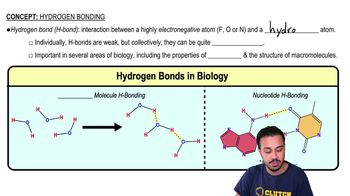
Hydrogen Bonding
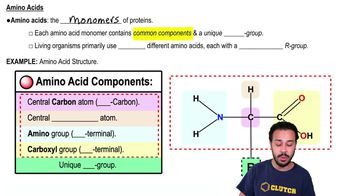
Amino Acid Structure
Amino acids consist of a central carbon atom bonded to an amino group, a carboxyl group, a hydrogen atom, and a variable side chain (R group). The nature of the side chain determines the properties of the amino acid, including its polarity, charge, and ability to form hydrogen bonds. Proline's unique side chain, which forms a ring structure, affects the flexibility of the polypeptide chain.
추천 영상:
가이드 코스
Amino Acids
Proline's Side Chain
Proline is unique among amino acids because its side chain is bonded to the backbone nitrogen, creating a cyclic structure. This configuration restricts the rotation around the peptide bond, leading to reduced flexibility in the protein's backbone. Consequently, proline often introduces kinks or turns in protein structures, influencing their overall conformation.
추천 영상:
가이드 코스
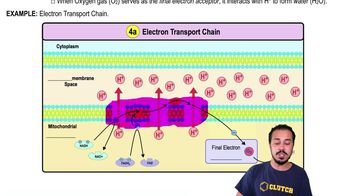
Electron Transport Chain
관련 실천
교과서 질문
2734
views
교과서 질문
Why are proteins not considered to be a good candidate for the first living molecule?
a. Their catalytic capability is not sufficient for most biological reactions.
b. Their amino acid monomers were not likely present in the prebiotic soup.
c. They cannot serve as a template for replication.
d. They could not have polymerized from amino acid monomers under early Earth conditions.
2868
views
교과서 질문
Explain how molecular chaperones facilitate protein folding in many different polypeptides, each with their own specific shape.
2153
views
교과서 질문
Predict the effect on protein function if each polypeptide adopted only a single, inflexible shape based on its primary structure.
2286
views
