
교과서 질문
What does the cuticle do?
What do stomata do?
Predict how the thickness of the cuticle and the number of stomata differ in plants from wet habitats versus dry habitats.
896
views

 검증된 단계별 안내
 06:52
06:52
 06:58 06:52
What does the cuticle do?
What do stomata do?
Predict how the thickness of the cuticle and the number of stomata differ in plants from wet habitats versus dry habitats.
You attached a birdfeeder to a tree 5 years ago at a position 6 feet above the ground. The tree has grown since at a rate of 1 foot per year. What is the current height of the birdfeeder?
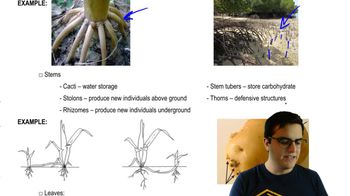
Identify the structure you are consuming when you eat each of the following: Asparagus, Brussels sprouts, celery, spinach, carrots, and potatoes.
Describe the general function of the shoot and the general function of the root system. Which tissues are continuous throughout these two systems?
Suggest a hypothesis to explain why the shoot and root systems of different species are so variable in size and shape.
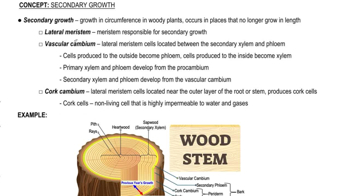
Which statement best characterizes secondary growth?
a. It results from cell divisions in the vascular and cork cambia.
b. It increases the length of the plant stem.
c. It results from divisions in the apical meristem cells.
d. It often produces phloem cells to the inside and xylem cells to the outside of the vascular cambium.
Which statement best characterizes primary growth?
a. It does not occur in roots, only in shoots.
b. It leads to the development of cork tissue.
c. It produces the dermal, ground, and vascular tissues.
d. It produces rings of xylem, phloem, and cork tissue.