
Ch. 36 - Plant Nutrition
Freeman - Biological Science 8th Edition
Freeman8th EditionBiological ScienceISBN: 9780138276263당신이 사용하는 게 아니라요?교과서 변경
36장, 문제 5

Suppose that certain root cells have an overall charge that is more negative than normal. What impact would this likely have on the uptake of anions such as NO3⁻?
a. Anions would be less likely to enter roots.
b. Anions would be more likely to enter roots.
c. This would have no impact on the ability of anions to enter roots.
d. This would make anions and cations equally likely to enter roots.

검증된 단계별 안내
1
Understand the charge dynamics: Root cells typically have a negative charge inside compared to the outside. This charge difference is crucial for the movement of ions across the cell membrane.
Consider the nature of anions: Anions, such as NO3−, carry a negative charge. Like charges repel each other, while opposite charges attract.
Analyze the impact of increased negative charge: If the root cells become more negatively charged than normal, the repulsion between the negatively charged cell interior and the anions would increase.
Predict the effect on anion uptake: Due to the increased repulsion, anions like NO3− would be less likely to enter the root cells, as they would be repelled by the more negative charge inside the cells.
Conclude the most likely outcome: Based on the analysis, the increased negative charge inside the root cells would likely decrease the uptake of anions, making option 'a' the most plausible choice.

비슷한 문제에 대한 검증된 영상 답변:

이 영상 해법은 위 문제에 도움이 된다고 튜터들이 추천한 것입니다.
영상 길이:
4m
도움이 되었나요?

주요 개념

질문에 올바르게 답하기 위해 반드시 이해해야 하는 핵심 개념들은 다음과 같습니다.

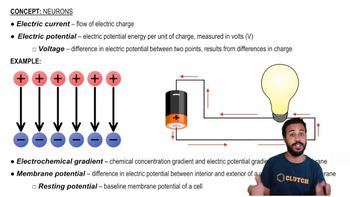
Membrane Potential

Membrane potential refers to the voltage difference across a cell's plasma membrane, resulting from the distribution of ions. A more negative membrane potential can influence the movement of charged particles, such as anions and cations, across the membrane. This potential is crucial for understanding how ions like NO3− are transported into root cells.
추천 영상:
가이드 코스
10:31
Membrane Potential

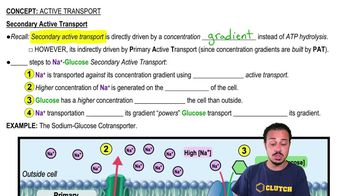
Ion Transport Mechanisms

Ion transport mechanisms involve the movement of ions across cell membranes through channels, carriers, or pumps. Anions like NO3− typically enter cells via specific transport proteins. The charge of the cell membrane can affect these mechanisms, making it easier or harder for anions to be transported depending on the electrochemical gradient.
추천 영상:
가이드 코스
07:06
Secondary Active Transport

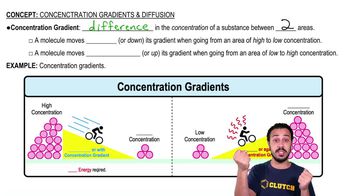
Electrochemical Gradient

The electrochemical gradient is the combined effect of the concentration gradient and electrical potential across a membrane. It drives the movement of ions into or out of cells. A more negative charge inside root cells can enhance the uptake of positively charged ions while potentially hindering the entry of negatively charged anions like NO3− due to repulsion.
추천 영상:
가이드 코스
04:51
Concentration Gradients and Diffusion
관련 실천
교과서 질문

Why is the presence of clay particles important in soil?

a. They provide macronutrients—particularly nitrogen, phosphorus, and potassium.

b. They bind metal ions, which would be toxic if absorbed by plants.

c. They allow water to percolate through the soil, making oxygen-rich air pockets available. d. The negative charges on clay bind to positively charged ions and prevent them from being leached out of the soil.

1171
views
교과서 질문

In a semester-long experiment tracking growth in plants, your lab partner—who often skips class—carefully records the mass of water added to a potted plant with the expectation that this addition will be fully accounted for in the mass gained by the plant. Is your lab partner right or wrong? Explain.

796
views
교과서 질문

Why are proton pumps in root-hair plasma membranes important?

a. They pump protons into cells, generating a membrane potential (voltage).

b. They allow toxins to be concentrated in vacuoles, so the toxins do not poison enzymes in the cytoplasm.

c. They set up an electrochemical gradient that makes it possible for roots to absorb cations and anions.

d. They set up the membrane voltage required for action potentials to occur.

879
views
교과서 질문

Your friend claims that all plants are autotrophs because they perform photosynthesis. Is that a correct statement? Explain.

612
views
교과서 질문

Why is it important for plants to exclude certain ions?

Summarize the difference between active and passive exclusion mechanisms.

835
views
교과서 질문

Where does most nutrient uptake occur in roots?

a. At the root cap, where root tissue first encounters soil away from the zone of nutrient depletion

b. At the Casparian strip, where ions must enter the symplast before entering xylem cells

c. In the symplastic and apoplastic pathways

d. In root hairs, in the zone of maturation

1304
views