Ch. 36 - Plant Nutrition
Freeman - Biological Science 8th Edition
Freeman8th EditionBiological ScienceISBN: 9780138276263당신이 사용하는 게 아니라요?교과서 변경
36장, 문제 9

There is a conflict between van Helmont's data on willow tree growth and the data on essential nutrients listed in Table 36.1. According to the table, nutrients other than C, H, and O should make up about 4 percent of a willow tree's mass. Most or all of these nutrients should come from soil. But van Helmont claimed that the soil in his experiment lost just 60 g, while the tree gained 74,000 g. Calculate the percentage of the added mass accounted for by soil, and compare it to the predicted 4 percent. State at least one hypothesis to explain the conflict between expected and observed results. How would you test this hypothesis?

검증된 단계별 안내
1
Calculate the percentage of the added mass accounted for by soil: (60 g / 74,000 g) * 100 = 0.081%.
Compare this to the predicted 4%: 0.081% is much lower than the expected 4%.
Hypothesis: The willow tree may have absorbed nutrients from sources other than soil, such as air or water.
Test the hypothesis: Conduct a controlled experiment where willow trees are grown in a closed system with only soil and water, and measure the mass gain and nutrient content.
Analyze the results: Compare the nutrient content and mass gain of the trees in the closed system to those in an open system to determine if additional nutrients are being absorbed from the air.

비슷한 문제에 대한 검증된 영상 답변:

이 영상 해법은 위 문제에 도움이 된다고 튜터들이 추천한 것입니다.
영상 길이:
2m
도움이 되었나요?

주요 개념

질문에 올바르게 답하기 위해 반드시 이해해야 하는 핵심 개념들은 다음과 같습니다.

Photosynthesis and Plant Growth

Photosynthesis is the process by which plants convert light energy into chemical energy, using carbon dioxide and water to produce glucose and oxygen. This process is essential for plant growth, as it provides the energy and organic compounds necessary for cellular functions. Understanding how plants utilize carbon, hydrogen, and oxygen from their environment is crucial for analyzing growth data and discrepancies in experimental results.
추천 영상:
가이드 코스
06:53
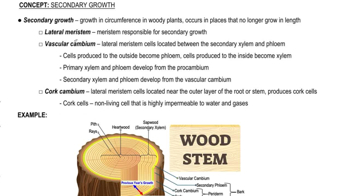
Secondary Growth

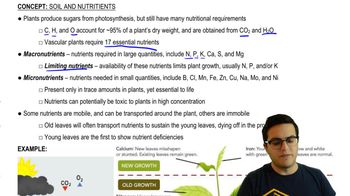
Essential Nutrients in Plants

Plants require various essential nutrients, which are divided into macronutrients and micronutrients, to thrive. Macronutrients like nitrogen, potassium, and calcium are needed in larger quantities, while micronutrients such as iron and zinc are required in trace amounts. The table indicates that these nutrients, primarily sourced from soil, contribute to plant mass and health, making it vital to consider their roles when evaluating growth discrepancies.
추천 영상:

Experimental Design and Hypothesis Testing

Experimental design involves creating a structured approach to test hypotheses and gather data. In the context of van Helmont's experiment, discrepancies between expected and observed results prompt the formulation of hypotheses to explain the differences. Testing these hypotheses may involve controlled experiments that manipulate variables such as nutrient availability or soil composition to determine their effects on plant growth.
추천 영상:
가이드 코스
02:50
Experimental Design Example 1
관련 실천
교과서 질문

The carnivorous plant Nepenthes bicalcarata ('fanged pitcher plant') has a unique relationship with a species of ant—Camponotus schmitzi ('diving ant'). The diving ants are not digested by the pitcher plants, but instead live on the plants and consume nectar. Diving ants also dive into the digestive juices in the pitcher, swim to the bottom, and capture and consume trapped insects, leaving uneaten body parts and ant feces behind.

What nutritional impact do the ants have on fanged pitcher plants?

Do the pitcher plants derive any nutritional benefit from this relationship?

Nitrogen is a key nutrient often obtained by carnivorous plants from the insects they digest. Are the results presented here what would be expected if nitrogen is a limiting nutrient? Explain.

961
views
교과서 질문

In a semester-long experiment tracking growth in plants, your lab partner—who often skips class—carefully records the mass of water added to a potted plant with the expectation that this addition will be fully accounted for in the mass gained by the plant. Is your lab partner right or wrong? Explain.

796
views
교과서 질문

The carnivorous plant Nepenthes bicalcarata ('fanged pitcher plant') has a unique relationship with a species of ant—Camponotus schmitzi ('diving ant'). The diving ants are not digested by the pitcher plants, but instead live on the plants and consume nectar. Diving ants also dive into the digestive juices in the pitcher, swim to the bottom, and capture and consume trapped insects, leaving uneaten body parts and ant feces behind. What nutritional impact do the ants have on fanged pitcher plants? Do the pitcher plants derive any nutritional benefit from this relationship? Based only on the information provided here, make a prediction on the effect of diving ants on overall pitcher plant growth.

591
views
교과서 질문

Your friend claims that all plants are autotrophs because they perform photosynthesis. Is that a correct statement? Explain.

612
views
교과서 질문

Why is it important for plants to exclude certain ions?

Summarize the difference between active and passive exclusion mechanisms.

835
views
교과서 질문

Design an experiment, using radioactive carbon and the heavy isotope of nitrogen (15N2), that would test whether the Rhizobia–pea plant interaction is mutualistic.

852
views