
Ch. 37 - Plant Sensory Systems, Signals, and Responses
Freeman - Biological Science 8th Edition
Freeman8th EditionBiological ScienceISBN: 9780138276263당신이 사용하는 게 아니라요?교과서 변경
37장, 문제 8

Suppose that a mutant plant is unable to make methyl salicylate. Explain why it is not likely to survive in the wild.

검증된 단계별 안내
1
Step 1: Understand the role of methyl salicylate in plants. Methyl salicylate is a type of phenolic compound that is produced by many plants. It serves several functions, including attracting beneficial insects, repelling harmful insects, and communicating with other plants.
Step 2: Consider the consequences of a plant not being able to produce methyl salicylate. Without this compound, the plant would be more susceptible to insect damage and disease, as it would not be able to attract beneficial insects or repel harmful ones.
Step 3: Think about the plant's ability to communicate with other plants. Methyl salicylate is involved in plant-to-plant communication, particularly in response to stress. If a plant is unable to produce this compound, it may not be able to signal to other plants that it is under stress, which could affect the overall health of the plant community.
Step 4: Reflect on the plant's survival in the wild. In the wild, plants face many challenges, including competition for resources, predation by insects, and disease. Without the ability to produce methyl salicylate, a plant would be at a significant disadvantage in dealing with these challenges.
Step 5: Conclude that a mutant plant that is unable to produce methyl salicylate is not likely to survive in the wild. This is because it would be more susceptible to insect damage and disease, less able to communicate with other plants, and less able to compete for resources.

비슷한 문제에 대한 검증된 영상 답변:

이 영상 해법은 위 문제에 도움이 된다고 튜터들이 추천한 것입니다.
영상 길이:
57s
도움이 되었나요?

주요 개념

질문에 올바르게 답하기 위해 반드시 이해해야 하는 핵심 개념들은 다음과 같습니다.

Methyl Salicylate

Methyl salicylate is a volatile organic compound produced by many plants, particularly in response to stress or injury. It plays a crucial role in plant defense by acting as a signaling molecule that can trigger systemic acquired resistance, helping plants to fend off pathogens and herbivores.
추천 영상:
03:39
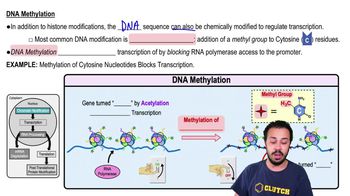
DNA Methylation

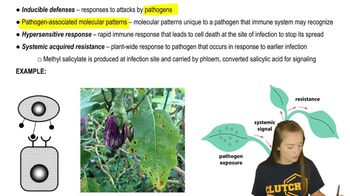
Plant Defense Mechanisms

Plants have evolved various defense mechanisms to protect themselves from biotic stressors like pests and diseases. These mechanisms include physical barriers, chemical defenses, and signaling pathways that activate protective responses, such as the production of secondary metabolites like methyl salicylate.
추천 영상:
08:59
Pathogen Defenses

Survival in the Wild

Survival in the wild depends on a plant's ability to adapt to environmental challenges, including herbivory and disease. A plant that cannot produce essential defense compounds like methyl salicylate may be more susceptible to attacks, leading to reduced fitness, lower reproductive success, and ultimately, a decreased chance of survival in competitive ecosystems.
추천 영상:
가이드 코스
03:28
Postzygotic Barriers
관련 실천
교과서 질문

In general, small seeds that have few food reserves must be exposed to red light before they will germinate. (Lettuce is an example.) In contrast, large seeds that have substantial food reserves typically do not depend on red light as a stimulus to trigger germination. State a hypothesis to explain these observations.

620
views
교과서 질문

To explore how hormones function, researchers have begun to transform plants with particular genes. In one experiment, a gene involved in cytokinin synthesis was introduced into tobacco plants. Which one of the following results would be expected?

a. Individuals produced more lateral branches.

b. Stems grew extremely tall and slender.

c. Roots were incapable of responding to gravity.

d. Stomata were closed most of the time.

777
views
교과서 질문

Why was it logical to predict that amyloplasts function as statoliths?

a. They are dense and settle to the bottom of gravity-sensing cells.

b. They are present only in gravity-sensing cells.

c. They make a direct physical connection with membrane proteins that have been shown to be gravity-receptor molecules.

d. Their density changes in response to gravity.

659
views
교과서 질문

Phytochromes can be considered 'shade detectors,' while phototropins such as PHOT1 can be considered 'sunlight detectors.' Explain why these characterizations are valid.

719
views
교과서 질문

Leaflets of Mimosa pudica (common names: sensitive plant, touch-me-not) have a remarkable ability to close up in response to being touched or physically moved.

How fast can the leaflets close?

How does this occur?

And more importantly, what benefit could this unusual response provide to the plant?

Researchers studied the rate of closing and reopening of leaflets by measuring changes in the distance between opposing leaflets after being touched. Their results are shown in the accompanying graph (d/dmax is actual leaflet distance relative to maximal leaflet distance).

How long does it take for leaflets to close?

How long to reopen?

729
views
교과서 질문

In many species native to tropical wet forests, seeds do not undergo a period of dormancy. Instead, they germinate immediately. Predict the role of ABA in these seeds. How would you test your prediction?

725
views