Ch. 39 - Animal Form and Function
Freeman - Biological Science 8th Edition
Freeman8th EditionBiological ScienceISBN: 9780138276263당신이 사용하는 게 아니라요?교과서 변경
39장, 문제 9

Explain why it would be impossible for a gorilla the size of King Kong to have fur. (Your answer should explain how the surface area to volume ratio of a normal-sized gorilla would compare to Kong's; relate this to the role of surface area and volume in heat generation and heat transfer, and consider the function of fur.)

검증된 단계별 안내
1
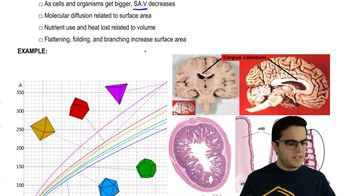
Understand the concept of surface area to volume ratio (SA:V ratio) and its importance in biology. The SA:V ratio decreases as the size of an organism increases. This means that larger organisms have relatively less surface area compared to their volume.
Relate the SA:V ratio to heat generation and heat transfer. Larger animals generate more heat internally due to their greater volume, but have relatively less surface area to lose this heat. This can lead to overheating if not managed properly.
Consider the function of fur in normal-sized gorillas. Fur acts as an insulator, reducing heat loss from the body through the surface. It helps to maintain body temperature in colder environments.
Apply these concepts to a hypothetical gorilla the size of King Kong. Due to the extremely low SA:V ratio, such a large creature would generate a vast amount of internal heat. With relatively less surface area to dissipate this heat, retaining fur would exacerbate the risk of overheating.
Conclude that a gorilla the size of King Kong would likely need adaptations to enhance heat loss rather than retain it. Lack of fur or having thinner or less dense fur could be such an adaptation, helping to prevent overheating by allowing more heat to escape from the body.

비슷한 문제에 대한 검증된 영상 답변:

이 영상 해법은 위 문제에 도움이 된다고 튜터들이 추천한 것입니다.
영상 길이:
2m
도움이 되었나요?

주요 개념

질문에 올바르게 답하기 위해 반드시 이해해야 하는 핵심 개념들은 다음과 같습니다.

Surface Area to Volume Ratio

The surface area to volume ratio (SA:V) is a critical concept in biology that describes how the surface area of an object compares to its volume. As an object's size increases, its volume grows faster than its surface area, leading to a lower SA:V ratio. This ratio affects various physiological processes, including heat exchange, as smaller animals lose heat more quickly due to their higher SA:V ratio compared to larger animals.
추천 영상:
가이드 코스
07:47
Surface Area to Volume Ratio

Heat Generation and Transfer

Heat generation in organisms is primarily a result of metabolic processes, while heat transfer occurs through mechanisms such as conduction, convection, and radiation. In larger animals, like a hypothetical giant gorilla, the lower SA:V ratio means that heat generated internally would not dissipate as efficiently as in smaller animals. This can lead to overheating, as the volume of body mass generates more heat than the surface area can effectively release.
추천 영상:
가이드 코스
04:42
Horizontal Gene Transfer

Function of Fur

Fur serves multiple functions, including insulation, protection, and camouflage. In terms of thermoregulation, fur helps to retain body heat in smaller animals by trapping air, which acts as an insulator. However, for a very large animal like a King Kong-sized gorilla, the insulating properties of fur would be less effective due to the increased body mass and reduced SA:V ratio, making it difficult to maintain a stable body temperature without overheating.
추천 영상:
가이드 코스
06:04
Functional Groups
관련 실천
교과서 질문

Explain why most endotherms are homeothermic and most ectotherms are poikilothermic.

1029
views

교과서 질문

Many species of animals on islands are larger than related species on the mainland. Scientists hypothesize that this phenomenon, called island gigantism, evolved in response to the scarcity of competitors and predators on islands. Reduced competition and predation allow species to exploit more resources and free them from the need to hide in small refuges.

Which tortoises, mainland or island, need to eat more food per gram of their body mass?

574
views
교과서 질문

Consider three spheres with radii of 1 cm, 5 cm, and 10 cm.

Calculate the surface area and the volume of each sphere, and plot the results on a graph with radius on the x-axis and surface area and volume on the y-axis. (Surface area of a sphere = 4πr2; volume of a sphere = (4/3)πr3.)

Explain how the graph shows the relationship between size and surface area to volume ratio.

1342
views
교과서 질문

The dinosaur Apatosaurus (Brontosaurus) is one of the largest terrestrial animals that ever lived—over 20 m in length and weighing over 20 metric tons. Is it more likely that Apatosaurus was homeothermic or poikilothermic? Explain.

726
views
교과서 질문

Many species of animals on islands are larger than related species on the mainland. Scientists hypothesize that this phenomenon, called island gigantism, evolved in response to the scarcity of competitors and predators on islands. Reduced competition and predation allow species to exploit more resources and free them from the need to hide in small refuges. The graph shown here compares the average carapace (shell) length of mainland and island tortoises. Summarize the results, then use the data to predict whether the surface area to volume ratio is higher in mainland or island tortoises.

638
views