Ch.4 - Nucleic Acids and the RNA World
Freeman - Biological Science 8th Edition
Freeman8th EditionBiological ScienceISBN: 9780138276263당신이 사용하는 게 아니라요?교과서 변경
4장, 문제 4

Single strands of nucleic acids are directional, meaning that there are two different ends. What functional groups define the two different ends of a strand?

검증된 단계별 안내
1
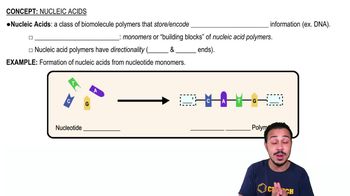
Identify the structure of nucleic acids: Nucleic acids, such as DNA and RNA, are polymers made up of monomer units called nucleotides. Each nucleotide consists of a phosphate group, a sugar (deoxyribose in DNA and ribose in RNA), and a nitrogenous base.
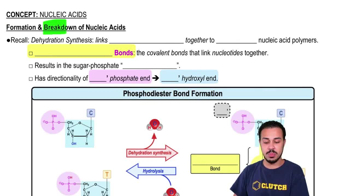
Understand the composition of the backbone: The backbone of a nucleic acid strand is formed by alternating phosphate and sugar groups. The phosphate group of one nucleotide connects to the sugar of the next nucleotide through phosphodiester bonds.
Recognize the directionality of nucleic acids: Nucleic acid strands have directionality due to the orientation of the sugar-phosphate backbone. One end of the strand has a free phosphate group attached to the 5' carbon of the sugar, known as the 5' end.
Identify the 3' end: The other end of the strand has a free hydroxyl group (-OH) attached to the 3' carbon of the sugar, known as the 3' end.
Summarize the functional groups: The two different ends of a nucleic acid strand are defined by the presence of a phosphate group at the 5' end and a hydroxyl group at the 3' end.

비슷한 문제에 대한 검증된 영상 답변:

이 영상 해법은 위 문제에 도움이 된다고 튜터들이 추천한 것입니다.
영상 길이:
52s
도움이 되었나요?

주요 개념

질문에 올바르게 답하기 위해 반드시 이해해야 하는 핵심 개념들은 다음과 같습니다.

Nucleic Acid Structure

Nucleic acids, such as DNA and RNA, are polymers made up of nucleotide monomers. Each nucleotide consists of a sugar, a phosphate group, and a nitrogenous base. The sugar-phosphate backbone forms the structural framework of the nucleic acid, with the sequence of nitrogenous bases encoding genetic information.
추천 영상:
03:22
Nucleic Acids

5' and 3' Ends

The terms 5' (five prime) and 3' (three prime) refer to the orientation of the sugar molecule in the nucleotide. The 5' end has a phosphate group attached to the fifth carbon of the sugar, while the 3' end has a hydroxyl group attached to the third carbon. This directional property is crucial for processes like DNA replication and transcription.
추천 영상:
04:07
Formation & Breakdown of Nucleic Acids

Functional Groups

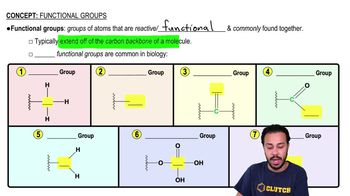
Functional groups are specific groups of atoms within molecules that are responsible for the characteristic chemical reactions of those molecules. In nucleic acids, the phosphate group at the 5' end and the hydroxyl group at the 3' end are key functional groups that define the polarity and reactivity of the nucleic acid strand.
추천 영상:
06:04
Functional Groups
관련 실천
교과서 질문

What determines the primary structure of a DNA molecule?

a. Stem-and-loop configuration

b. Complementary base pairing

c. Deoxyribonucleotide sequence

d. Hydrophobic interactions and hydrogen bonding

2602
views
교과서 질문

Evaluate the following statements related to the synthesis of nucleic acids. Select True or False for each statement.

T/F Ribonucleotides are added to the 3′ end of a DNA strand.

T/F Polymerization of nucleic acids occurs by the formation of phosphodiester bonds.

T/F Complementary pairing between sugars is required for copying nucleic acids.

T/F Strands in a double helix are synthesized in an antiparallel orientation.

1760
views
교과서 질문

If nucleotides from the DNA of a human were quantified and 30 percent of them contained the base adenine, what percentage of them would contain the base guanine?

a. 20 percent

b. 30 percent

c. 40 percent

d. 70 percent

2599
views
교과서 질문

What would be the sequence of the strand of DNA that is made from the following template: 5′-GATATCGAT-3′? (Your answer must be written 5'→3'.) How would the sequence be different if RNA were made from this DNA template?

2078
views
교과서 질문

What is responsible for the increased stability of DNA compared to RNA?

2897
views
교과서 질문

What are the four nitrogenous bases found in RNA?

a. Cytosine, guanine, thymine, uracil (C, G, T, U)

b. Adenine, cytosine, guanine, thymine (A, C, G, T)

c. Adenine, cytosine, guanine, uracil (A, C, G, U)

d. Alanine, cysteine, glycine, threonine (A, C, G, T)

2808
views