
Ch. 44 - Animal Sensory Systems
Freeman - Biological Science 8th Edition
Freeman8th EditionBiological ScienceISBN: 9780138276263당신이 사용하는 게 아니라요?교과서 변경
44장, 문제 2

Evaluate the following statements according to the information presented in this chapter. Select True or False for each statement.
T/F Most human eyes have one type of rod and three types of cones.
T/F Rods are more sensitive to dim light than cones are.
T/F Nocturnal animals have fewer rods than diurnal animals.
T/F Both rods and cones use retinal and opsins to detect light.

검증된 단계별 안내
1
Understand the function of rods and cones in the human eye: Rods are responsible for vision in low light conditions, while cones are responsible for color vision and function best in bright light.
Evaluate the statement about the types of rods and cones: Most human eyes have one type of rod and three types of cones, which are sensitive to different wavelengths of light (red, green, and blue).
Consider the sensitivity of rods and cones: Rods are more sensitive to dim light than cones, which is why they are more effective in low-light conditions.
Analyze the statement about nocturnal and diurnal animals: Nocturnal animals typically have more rods than diurnal animals to enhance their ability to see in the dark.
Examine the use of retinal and opsins: Both rods and cones use retinal and opsins to detect light, which are essential components of the phototransduction pathway.

비슷한 문제에 대한 검증된 영상 답변:

이 영상 해법은 위 문제에 도움이 된다고 튜터들이 추천한 것입니다.
영상 길이:
1m
도움이 되었나요?

주요 개념

질문에 올바르게 답하기 위해 반드시 이해해야 하는 핵심 개념들은 다음과 같습니다.

Rod and Cone Cells

Rod and cone cells are photoreceptor cells in the retina responsible for vision. Rods are highly sensitive to low light levels and are crucial for night vision, while cones are responsible for color vision and function best in bright light. Humans typically have one type of rod and three types of cones, each sensitive to different wavelengths of light.
추천 영상:

Sensitivity to Light

Sensitivity to light refers to the ability of photoreceptor cells to detect light intensity. Rods are more sensitive to dim light compared to cones, making them essential for vision in low-light conditions. This sensitivity allows rods to function effectively at night or in dark environments, whereas cones require brighter light to activate and provide detailed color vision.
추천 영상:
가이드 코스
15:15
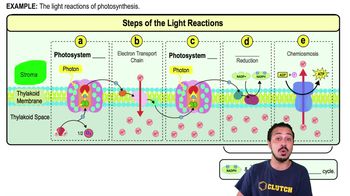
Steps of the Light Reactions

Retinal and Opsins

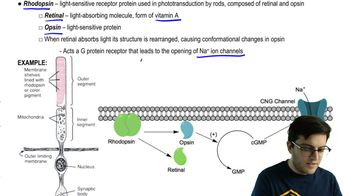
Retinal and opsins are molecules involved in the phototransduction process, which is the conversion of light into electrical signals in the retina. Both rods and cones use retinal, a form of vitamin A, and opsins, proteins that bind to retinal, to detect light. The interaction between retinal and opsins triggers a biochemical cascade that ultimately leads to visual perception.
추천 영상:
관련 실천
교과서 질문

Which of these statements about taste is true?

a. Sweetness is a measure of the concentration of hydrogen ions in food.

b. Sodium ions from foods can directly depolarize certain taste cells.

c. All bitter-tasting compounds have a similar chemical structure.

d. Sourness is detected when hydrogen ions bind to membrane receptors.

769
views
교과서 질문

In the human ear, how do different hair cells respond to different frequencies of sound?

a. Waves of pressure move through the fluid in the cochlea.

b. Hair cells are 'sandwiched' between membranes.

c. Receptor proteins in the stereocilia of each hair cell are different; each protein responds to a certain range of frequencies.

d. Because the basilar membrane varies in stiffness, it vibrates in certain places in response to certain frequencies.

1633
views
교과서 질문

Considering that sounds and odors both trigger changes in the patterns of action potentials in sensory neurons, how does the brain perceive which sense is which when the action potentials reach the brain?

a. The action potentials stimulated by sounds are different in size and shape from those stimulated by odors.

b. The axons from different sensory neurons go to different areas of the brain.

c. Mechanoreception is not consciously perceived by the brain, whereas chemoreception is.

d. Chemoreception is not consciously perceived by the brain, whereas mechanoreception is.

887
views
교과서 질문

What type of sensory system do migrating birds use to detect direction?

808
views