Ch. 48 - The Immune System in Animals
Freeman - Biological Science 8th Edition
Freeman8th EditionBiological ScienceISBN: 9780138276263당신이 사용하는 게 아니라요?교과서 변경
48장, 문제 3

What is the difference between an epitope and an antigen?

검증된 단계별 안내
1
An antigen is a molecule or molecular structure, often a protein or polysaccharide, that can be bound by an antigen-specific antibody or antigen receptor on B and T cells. Antigens are typically foreign substances that enter the body and trigger an immune response.
An epitope, also known as an antigenic determinant, is a specific part of the antigen that is recognized and bound by an antibody. It is a small, specific region on the larger antigen molecule.
While an antigen can have multiple epitopes, each epitope is recognized by a specific antibody. This means that a single antigen can stimulate the production of multiple types of antibodies, each specific to a different epitope.
The distinction between an antigen and an epitope is crucial in understanding how the immune system recognizes and responds to pathogens. Antigens are the targets, and epitopes are the precise points where antibodies attach.
In vaccine development, understanding the specific epitopes on an antigen that provoke a strong immune response can help in designing effective vaccines that target these critical regions.

비슷한 문제에 대한 검증된 영상 답변:

이 영상 해법은 위 문제에 도움이 된다고 튜터들이 추천한 것입니다.
영상 길이:
1m
도움이 되었나요?

주요 개념

질문에 올바르게 답하기 위해 반드시 이해해야 하는 핵심 개념들은 다음과 같습니다.

Antigen

An antigen is a substance that can provoke an immune response in the body. Typically, antigens are foreign molecules such as proteins or polysaccharides found on the surface of pathogens like bacteria and viruses. When detected by the immune system, antigens trigger the production of antibodies, which are specific proteins that help neutralize or eliminate the threat.
추천 영상:
가이드 코스
03:50
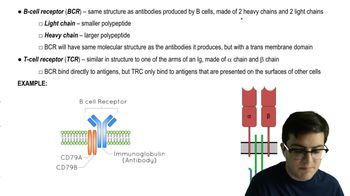
Antigen Receptors

Epitope

An epitope, also known as an antigenic determinant, is a specific part of an antigen that is recognized by the immune system, particularly by antibodies or T-cell receptors. Epitopes can be linear, consisting of a sequence of amino acids, or conformational, formed by the three-dimensional structure of the antigen. The interaction between epitopes and immune receptors is crucial for the specificity of the immune response.
추천 영상:
가이드 코스
03:43
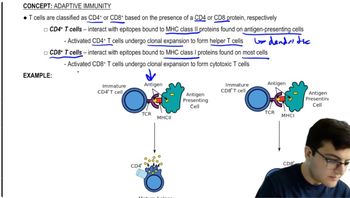
Antigen Presentation and Cytotoxic T Cells

Immune Response

The immune response is the body's defense mechanism against foreign invaders, such as pathogens. It involves the recognition of antigens and the activation of various immune cells, including B cells and T cells. The immune response can be innate (immediate and non-specific) or adaptive (specific and slower to develop), with the latter providing long-term immunity through memory cells that remember specific epitopes.
추천 영상:
가이드 코스
05:20
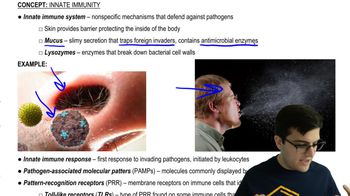
Innate Immune Response
관련 실천
교과서 질문

Explain how gene recombination leads to the production of vast numbers of different B-cell receptors.

713
views
교과서 질문

What steps are required for most B cells to become fully activated and differentiate into plasma cells?

1309
views
교과서 질문

What is one of the differences between CD4+ and CD8+ T cells?

a. CD4+ cells are immature, and CD8+ cells are mature.

b. CD4+ cells are activated, and CD8+ cells are not.

c. CD4+ cells interact with class II MHC proteins, and CD8+ cells interact with class I MHC proteins.

d. CD4+ cells activate cell-mediated responses, and CD8+ cells activate humoral responses.

1938
views
교과서 질문

What is the primary difference between the innate and adaptive immune responses?

a. The innate immune response does not distinguish between pathogens, while the adaptive immune response does.

b. Only the innate immune response is activated by antigens.

c. The adaptive immune response generates immunological memory and is more specific than the innate immune response.

d. The innate immune response does not kill cells; the adaptive immune response does.

1613
views
1
rank
교과서 질문

The overall role of the inflammatory response is to

a. Contain and eliminate foreign cells and material at the site of infection.

b. Increase heat at the site of infection to activate enzymes used in the immune response.

c. Produce antibodies that bind to and eliminate invading cells.

d. Increase blood flow at the site of a wound to flush out invading pathogens.

1270
views